Question
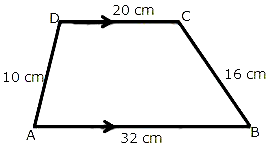
Trapezium given below; find its area.

Answer


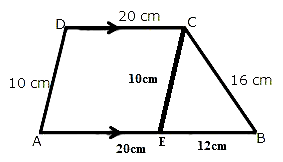
For the $\triangle EBC,$
$S = 19\ cm$
Area of $\triangle EBC = \sqrt{19 \times(19-16) \times(19-12) \times(19-10)}$
$=\sqrt{19 \times 3 \times 7 \times 9}$
$=59.9 \text { sq. } \ cm $
Let $h$ be the height.
Area of $\triangle EBC=\frac{1}{2} \times 12 \times h$
$\Rightarrow 59.9 = 6\ h$
$\Rightarrow h =\frac{59.9}{6}=9.98 \ cm$
Area of $\text{ABCD} =\frac{1}{2} \times(20+32) \times 9.98$
$=\frac{1}{2} \times 52 \times 9.98$
$=259.48 \ cm ^2$

Need a full question paper?

Generate a complete, print-ready paper with questions like this in minutes — across 16+ boards, with answer keys.
Start Generating Free

Similar questions

For the pair of linear equations given below, draw graphs and then state, whether the lines drawn are parallel or perpendicular to each other.$3x + 4y = 24,\frac{x}{4}+\frac{y}{3}=1$
Prove that the diagonals of a parallelogram divide it into four triangles of equal area.
The internal length, breadth, and height of a box are $30 \ cm, 24 \ cm,$ and $15 \ cm$. Find the largest number of cubes which can be placed inside this box if the edge of each cube is$(i) 3 \ cm (ii) 4 \ cm (iii) 5 \ cm$
The areas of two similar triangles are $16\ cm^2$ and $9\ cm^2$ respectively. If the altitude of the smaller triangle is $1.8\ cm$, find the length of the altitude corresponding to the larger triangle.
In a quadrilateral $\text{ABCD};$ prove that:$(i) AB+ BC + CD > DA,(ii) AB + BC + CD + DA > 2AC,(iii) AB + BC + CD + DA > 2BD$
The sum of the interior angles of a polygon is $6.5$ times the sum of its exterior angles. Find the number of sides of the polygon.
$\text{ABCD}$ is a quadrilateral in which diagonals $AC$ and $BD$ intersect at a point $O$. Prove that: area $\triangle AOD +$ area $\triangle BOC +$ area $\triangle ABO +$ area $\triangle CDO.$
A wire when bent in the form of a square encloses an area $= 576 \ cm^2$. Find the largest area enclosed by the same wire when bent to form;$(i)$ an equilateral triangle.$(ii)$ A rectangle whose adjacent sides differ by $4 \ cm.$
If $x + y + z = p$ and $xy + yz + zx = q$; find $x^2 + y^2 + z^2$.
Construct a triangle using the given data: $PQ = 4.8\ cm, QR = 6.3\ cm$ and $PR = 5.5\ cm$