Question
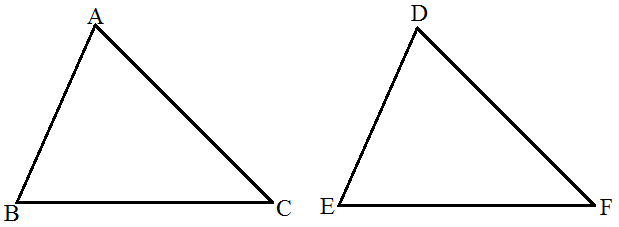
Triangle ABC and DEF are similar.
If area $\big(\triangle\text{ABC}\big) =16\text{cm}^2,$ area $\big(\triangle\text{DEF}\big) =25\text{cm}^2 $ and BC = 2.3cm, find EF.
Answer

$\because\triangle\text{ABC}\sim\triangle\text{DEF},$
$\therefore\frac{\text{area}(\triangle\text{ABC)}}{\text{area}(\triangle\text{DEF)}}=\frac{\text{BC}^2}{\text{EF}^2}$

$\Rightarrow\frac{16}{25}=\frac{(2.3)^2}{\text{EF}^2}\Rightarrow\frac{(4)^2}{(5)^2}=\frac{(2.3)^2}{\text{EF}^2}$
$\Rightarrow\frac{4}{5}=\frac{2.3}{\text{EF}}\Rightarrow\text{EF}=\frac{2.3\times5}{4}$
$\therefore\text{EF}=\frac{11.5}{4}=2.875\text{cm}$

Need a full question paper?

Generate a complete, print-ready paper with questions like this in minutes — across 16+ boards, with answer keys.

Start Generating Free

Similar questions

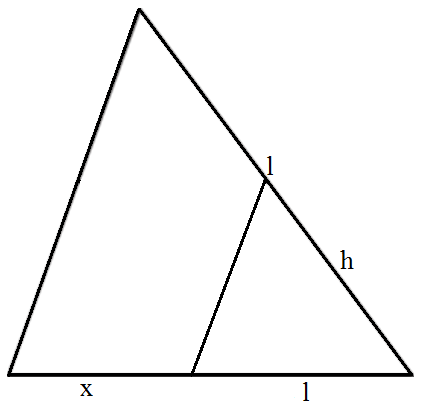
In the figure given below, a line segment is drawn parallel to one side of the triangle and the lengths of certain line-segment are marked. Find the value of x in the following:
Justify whether it is true to say that the sequence, having following $n ^{\text {th }}$ term is an A.P.
$a_n=1+n+n^2$.
If graph of quadratic polynomial $ax^2 + bx + c$ cuts positive direction of y-axis, then what is the sign of $c$?
The ratio between the radius of the base and the height of a cylinder is $2 : 3$. If the volume of the cylinder is $12936\ cm^3$​​​​​​​, then find the radius of the base of the cylinder.
If the distance between the points (4, k) and (1, 0) is 5, then what can be the possible values of k?
How many terms are there in the A.P. 187, 194, 201, ..., 439 ?
While calculating the mean of a given data by the assumed-mean method, the following values were obtained:
$\text{A}=25,\ \sum\text{f}_\text{i}\text{d}_\text{d}=110,\ \sum\text{f}_\text{i}=50.$
Find the mean.
Solve the following quadratic equation by factorisation method:
$m^{2}+14m+13=0$
The shape of the cross section of a canal is a trapezium. If the canal is $10\ m$ wide at the top, 6m wide at the bottom and the area of its cross section is $640\ m^2$​​​​​​​, find the depth of the canal.
Examine each of the following statements and comment:
If a die in thrown once, there are two possible outcomes - an odd number or an even number. Therefore, the probability of obtaining an odd number is $\frac{1}{2}$ and the probability of obtaining an even number is $\frac{1}{2}$.