Question
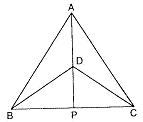
$\triangle ABC$ and $\triangle DBC$ are two isosceles triangles on the same base $BC$ and vertices $A$ and $D$ are on the same side of $BC$ . If $A D$ is extended to intersect $B C$ at $P$, show that :
$1. \triangle ABD \cong \triangle ACD$
$2. \triangle ABP \cong \triangle ACP$
$3. AP$ bisects $\angle A$ as well as $\angle D$
$4. AP$ is the perpendicular bisector of $BC.$

Answer

 
It is given in the question that:
$\triangle ABC$ and $\triangle DBC$ are two isosceles triangles
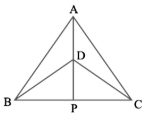
$i. \triangle ABC$ and $\triangle DBC$
$AD = AD ($Common$)$
$A B=A C ($Triangle $\text{ABC}$ is isosceles$)$
$B D=C D ($Triangle $\text{DBC}$ is isosceles$)$
By $\text{SSS}$ axiom,
$\triangle A B D \cong \triangle A C D$
$ii.$ In $\triangle A B P$ and $\triangle A C P$,
$AP = AP ($Common$)$
$\angle PAB =\angle PAC ($By $\text{c.p.c.t})$
$AB = AC ($Triangle $\text{DBC}$ is isoceles$)$
By $\text{SAS}$ axiom,
$\triangle A B P \cong \triangle A C P$
$iii. \angle PAB =\angle PAC (\text{c.p.c.t })$
$AP$ bisects $\angle A (i)$
Also,
In $\triangle B P D$ and $\triangle C P D$,
$PE = PD ($Common$)$
$B D=C D ($Triangle $\text{DBC}$ is isosceles$)$
$BP = CP (\triangle A B P \cong \triangle A C P$ so by $\text{c.p.c.t})$
By $\text{SSS}$ axiom,
$\triangle B P D \cong \triangle C P D$
Thus,
$\angle BDP=\angle CDP(\text { c.p.c.t })\text{(ii)}$
By $(i)$ and $(ii)$, we can say that $\angle A P$ bisects $\angle A$ as well as $D$
$iv. \angle BPD =\angle CPD ($ By $\text{c.p.c.t})$
And,
$B P=C P(i)$
Also, $\angle BPD =\angle CPD =180^{\circ}( BC$ is a straight line$)$
$2 \angle BPD=180^{\circ}$
$\angle B P D=90^{\circ} \text { (ii) }$
From $(i)$ and $(ii),$ we get
$A P$ is the perpendicular bisector of $B C$
 

Need a full question paper?

Generate a complete, print-ready paper with questions like this in minutes — across 16+ boards, with answer keys.

Start Generating Free

Similar questions

If $x^3 - 3x^2 + 3x - 7 = (x + 1)(ax^2 + bx + c)$, then $a + b + c =$
A field is in the shape of a trapezium having parallel sides $90m$ and $30\ m$. These sides meet the third side at right angles. The length of the fourth side is $100\ m$. If it costs Rs. $4$ to plough $1m^2 $of the field, find the total cost of ploughing the field.
The triangular side walls of a flyover have been used for advertisements. The sides of the walls are $122 m, 22 m$ and $120 m$ (see Fig.). The advertisements yield an earning of ₹ $5000$ per $m^2$ per year. A company hired one of its walls for $3$ months. How much rent did it pay?

Two parallel lines l and m are intersected by a transversal p. Show that the quadrilateral formed by the bisectors of interior angles is a rectangle.
In the given figure, $O$ is the centre of the circle, $BD = OD$ and $\text{CD}\perp\text{AB}.$ Find $\angle\text{CAB}.$
Simplify: $(a + b + c)^2 + (a - b + c)^2 + (a + b - c)^2$
The diameter of a cylinder is $28\ cm$ and its height is $40\ cm$. Find the curved surface, total surface area and the volume of the cylinder.
What length of tarpaulin $3 \ m$ wide will be required to make conical tent of height $8 \ m$ and base radius $6 \ m$? Assume that the extra length of material that will be required for stitching margins and wastage in cutting is approximately $20 \ cm$. $\left( \text{Use }\pi \text{ = 3}\text{.14} \right)$
The radius of a circle is $8\ cm$ and the length of one of its chords is $12\ cm$. Find the distance of the chord from the centre.
The base of a triangular field is three times its altitude. If the cost of sowing the field at $₹ 58$ per hectare is $₹ 783$, find its base and height.