Question
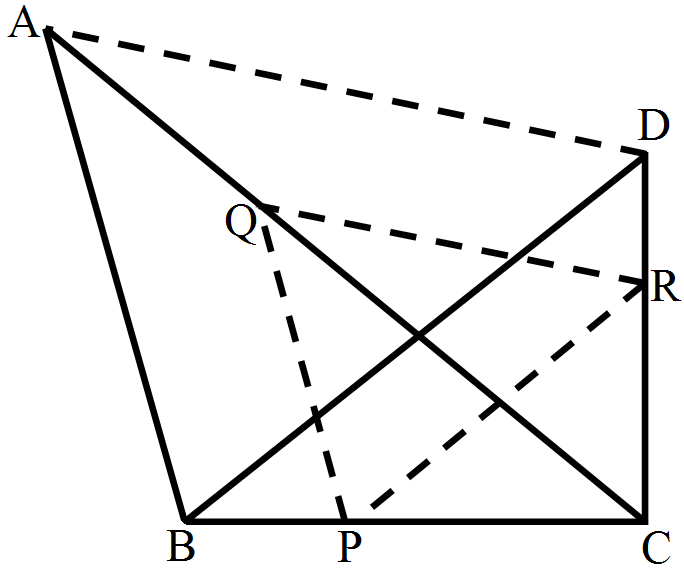
$\triangle\text{ABC}$ and $\triangle\text{DBC}$ lie on the same side of BC, as shown in the figure. From a point P on BC, PQ || AB and PR || BD are drawn, meeting AC at Q and CD at R respectively. Prove that QR || AD.
Answer

In $\triangle\text{CAB},\text{PQ }||\text{ AB}.$
Applying Thales' theorem, we get:
$\frac{\text{CP}}{\text{PB}}=\frac{\text{CQ}}{\text{QA}}\dots(1)$
Similarly, applying Thales' theorem $\triangle\text{BDC},$ where PR || BD, we get:
$\frac{\text{CP}}{\text{PB}}=\frac{\text{CR}}{\text{RD}}\dots(2)$
Hence, from (1) and (2), we have:
$\frac{\text{CQ}}{\text{QA}}=\frac{\text{CR}}{\text{RD}}$
Applying the converse of Thales' theorem, we conclude that QR || AD in $\triangle\text{ADC}.$
This completes the proof.

Need a full question paper?

Generate a complete, print-ready paper with questions like this in minutes — across 16+ boards, with answer keys.
Start Generating Free

Similar questions

Write the discriminant of the following quadratic equation.
$\sqrt{3}\text{x}^2+2\sqrt{2}\text{x}-2\sqrt{3}=0$
Areas of two similar triangles are 225 sq.cm & 81 sq.cm. If a side of the smaller triangle is 12 cm, then find corresponding side of the bigger triangle.
Find the ratio in which point P(k, 7) divides the segment joining A(8, 9) andB(1, 2). Also find k.
In a lottery of 50 tickets numbered 1 to 50, one ticket is drawn. Find the probability that the drawn ticket bears a prime number.
In ΔPQR seg PM is a median. Angle bisectors of ∠PMQ and ∠PMR intersect side PQ and side PR in points X and Y respectively. Prove that XY || QR.

Complete the proof by filling in the boxes. In $\triangle PMQ$, ray MX is bisector of $\angle PMQ$.
$\therefore\frac{\square}{\square}=\frac{\square}{\square}......... (I)$ theorem of angle bisector.
In $\triangle PMR$, ray MY is bisector of $\angle PMR$.
$\therefore\frac{\square}{\square}=\frac{\square}{\square}.........(II)$ theorem of angle bisector.
But $\frac{M P}{M Q}=\frac{M P}{M R}$ $\qquad$
$\therefore \frac{ PX }{ XQ }=\frac{ PY }{ YR }$ $\qquad$
$\therefore XY||QR......$ converse of basic proportionality theorem.
In $\triangle\text{ABC},\ \angle\text{C}=3\angle\text{B}=2(\angle\text{A}+\angle\text{B}).$ find the measure of each one of $\angle\text{A},\ \angle\text{B}$ and $\angle\text{C}.$
Prove the following.
tan4θ + tan2θ = sec4θ - sec2θ

A(4, 2), B(6, 5) and C(1, 4) are the vertices of ΔABC.
What do you observe?
In an A.P. the 10th term is 46, sum of the 5th and 7th term is 52. Find the A.P.