MCQ
$\triangle\text{ABC}$ is such that $AB = 3\ cm, BC = 2\ cm$ and $CA = 2.5\ cm$. If $\triangle\text{DEF}\sim\triangle\text{ABC}$ and $EF = 4\ cm,$ then perimeter of $\triangle\text{DEF}$ is :
  • A
    $7.5\ cm.$
  • $15\ cm.$
  • C
    $22.5\ cm.$
  • D
    $30\ cm.$

Answer

Correct option: B.
$15\ cm.$
$\triangle\text{DEF}\sim\triangle\text{ABC}$
$AB = 3\ cm, BC = 2\ cm, CA = 2.5\ cm, EF = 4\ cm.$
$\triangle\text{s}$ are similar
$\frac{\text{DE}}{\text{AB}}=\frac{\text{EF}}{\text{BC}}=\frac{\text{FD}}{\text{CA}}$
$\Rightarrow\frac{\text{DE}}{3}=\frac{4}{2}=\frac{\text{FD}}{2.5}$
Now $\frac{\text{DE}}{3}=\frac{4}{2}$
$\Rightarrow\text{DE}=\frac{3\times4}{2}=6\text{ cm}$
and $\text{FD}=\frac{4}{2}$
$\Rightarrow\text{FD}=\frac{4\times2.5}{2}=5\text{ cm}$
$\therefore$ Perimeter of $\triangle\text{DEF}$
$=6+4+5=15\text{ cm}.$

Need a full question paper?

Generate a complete, print-ready paper with questions like this in minutes — across 16+ boards, with answer keys.
Start Generating Free

Similar questions

There are two temples one on each bank of a river just opposite to each other. One temple is $40 m$ high. As observed from the top of this temple, the angle of depression of the top and foot of the other temple are $30^{\circ}$ and $60^{\circ}$ respectively. The width of river is
An observer $1.5m$ tall $28.5$ away from a tower and the angle of elevation of the top of the tower form the eye of the observer is $45^\circ$ . The height of the tower is :
If the sum of the roots of the equation $x^2- (k + 6)x + 2(2k - 1) = 0$ is equal to half of their product, then $k =$
If $4 \sec \theta-5=0$, then the value of $\cot \theta$ is :
Directions : In the following questions, the Assertions $(A)$ and Reason $(s)\ (R)$ have been put forward. Read both the statements carefully and choose the correct alternative from the following :
Assertion : The graphical representation of a pair of equations $4x + 3y - 1 = 5$ and $12x + 9y = 15$ will be parallel lines.
Reason : if the the given pair of equations has no solution.That means, the lines representing the given pair of equations are parallel to each other.
If HCF $(306,1314)=18$, then LCM $(306$, 1314) is
$\frac{\tan\theta}{\sec\theta-1}+\frac{\tan\theta}{\sec\theta + 1}$ is equal to :
Every linear equation in two variables has :
The mode of a frequency distribution can be determined graphically from:
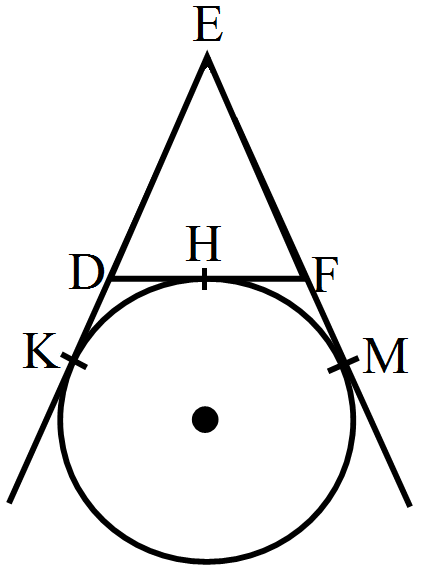
In the given figure, a circle touches the side DF of $\triangle\text{EDF}$ at H and touches ED and EF produced at K and M respectively. If EK = 9cm then the perimeter of $\triangle\text{EDF}$ is: