Question
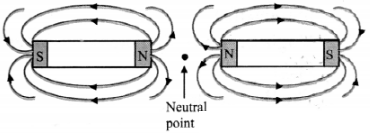
Two bar magnets are placed on a horizontal surface. Draw magnetic lines around them. Mark the position of any neutral points (points where there is no resultant magnetic field) on your diagram.
Answer

The magnetic lines of force between two magnets will depend on their relative positions. Considering the magnets to be placed one besides the other as shown in figure, the magnetic lines of force will be as shown.

Image

Need a full question paper?

Generate a complete, print-ready paper with questions like this in minutes — across 16+ boards, with answer keys.

Start Generating Free

Similar questions

In real life objects, never travel with uniform velocity, even on a horizontal surface, unless something is done? Why
is it so? What is to be done?
A satellite orbits around the Earth at a height equal to $R$ of the Earth. Find its period. $(R = 6.4 \times 10^6 m, g = 9.8 \ m/s^2)$
Define following terms in case of magnetic maps:
$i.$ Isomagnetic charts
$ii.$ Isodynamic lines
$iii.$ Isogonic lines
$iv.$ Aclinic lines
What is the variation in acceleration due to gravity with altitude?
A metre stick is balanced on a knife edge at its centre. When two coins, each of mass 5 g are put one on top of the other at the 12.0 cm mark, the stick is found to be balanced at 45.0 cm. What is the mass of the metre stick? (NCERT)
Find 'a' if $\overrightarrow{ A }=3 \hat{ i }-2 \hat{ j }+4 \hat{ k }$ and $\overrightarrow{ B }= a \hat{ i }+2 \hat{ j }-\hat{ k }$ are perpendicular to one another.
A projectile is thrown at an angle of $30^\circ $ to the horizontal. What should be the range of initial velocity (u) so that its range will be between $40\ m$ and $50\ m$? Assume $g = 10 m s^{-2}$.
The position vectors of three particles are given by$\overrightarrow{ x }_1=(5 \hat{ i }+5 \hat{ j }) m , \overrightarrow{ x }_2=(5 t \hat{ i }+5 t \hat{ j }) m$ and $\overrightarrow{ x }_3=\left(5 t \hat{ i }+10 t ^2 \hat{ j }\right) m$ as a function of time $t.$
Determine the velocity and acceleration for each, in $\text{SI}$ units.
Write short note on secondary cell.
The heating element connected to $230\  V$ draws a current of $5\  A$. Determine the amount of heat dissipated in $1$ hour $(J = 4.2 J/cal)$.