MCQ
Two blocks $1$ and $2$ of equal mass $m$ are connected by an ideal string (see figure below) over a frictionless pulley. The blocks are attached to the ground by springs having spring constants $k_1$ and $k_2$ such that $k_1 > k_2$. Initially, both springs are unstretched. Block $1$ is slowly pulled down a distance $x$ and released. Just after the release the possible values of the magnitudes of the accelerations of the blocks $a_1$ and $a_2$ can be
  • A
    either $\left(a_1=a_2=\frac{\left(k_1+k_2\right) x}{2 m}\right)$ or $\left(a_1=\frac{k_1 x}{m}-g\right.$ and $\left.a_2=\frac{k_2 x}{m}+g\right)$
     
  • $\left(a_1=a_2=\frac{\left(k_1+k_2\right) x}{2 m}\right)$ only
  • C
    $\left(a_1=a_2=\frac{\left(k_1-k_2\right) x}{2 m}\right)$ only
  • D
    either $\left(a_1=a_2=\frac{\left(k_1-k_2\right) x}{2 m}\right)$ $\text { or }\left( \alpha _1=a_2=\frac{\left(k_1 k_2\right) x}{\left(k_1+k_2\right) m}-g\right)$
Answer

Correct option: B.
$\left(a_1=a_2=\frac{\left(k_1+k_2\right) x}{2 m}\right)$ only
b
(b)

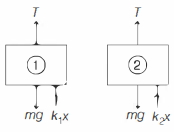
Free body diagram for block $1$ and $2$ are as shown below.

So, equations of force balance are

$T+k_1 x-m g =m a_1$

$\text { and }$ $k_2 x+m g-T =m a_2$

As string is in extensible,

$a_1=a_2=a \text { (let) }$

Then adding both equations, we have

$\left(k_1+k_2\right) x=2 m a$

$\Rightarrow \quad a=\left(\frac{k_1+k_2}{2 m}\right) \cdot x$

Need a full question paper?

Generate a complete, print-ready paper with questions like this in minutes — across 16+ boards, with answer keys.

Start Generating Free

Similar questions

A string is stretched between fixed points separated by $75.0\, cm$. It is observed to have resonant frequencies of $420\, Hz$ and $315\, Hz$. There are no other resonant frequencies between these two. Then, the lowest resonant frequency for this string is .... $Hz$
A metal ball immersed in alcohol weighs ${W_1}$ at $0°C$ and ${W_2}$ at $59°C.$ The coefficient of cubical expansion of the metal is less than that of alcohol. Assuming that the density of metal is large compared to that of alcohol, it can be shown that
A metallic wire of length $L$ is fixed between two rigid supports. If the wire is cooled through a temperature difference $\Delta T$ ($Y$ = young’s modulus, $\rho$ = density, $\alpha$ = coefficient of linear expansion) then the frequency of transverse vibration is proportional to : 
The speeds of $5$ molecules of a gas (in arbitrary units) are as follows : $2, 3, 4, 5, 6.$ The root mean square speed for these molecules is
Which is the correct unit for measuring nuclear radii
The displacement of a particle is proportional to the cube of time elapsed. How does the acceleration of the particle depends on time obtained
A heavy uniform chain lies on a horizontal table-top. If the coefficient of friction between the chain and table surface is $0.25$, then the maximum fraction of length of the chain, that can hang over one edge of the table is ...... $\%$
A particle moves with constant angular velocity in circular path of certain radius and is acted upon by a certain centripetal force $F$. If the angular velocity is doubled, keeping radius the same, the new force will be
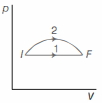
An ideal gas undergoes change in its state from the initial state $I$ to the final state $F$ via two possible paths as shown below. Then,
A capacitor acts as an infinite resistance for: