Question
Two blocks A and B of mass $m_A$ and $m_B$ respectively are kept in contact on a frictionless table. The experimenter pushes the block A from behind so that the blocks accelerate. If the block A exerts a force F on the block B, what is the force exerted by the experimenter on A?
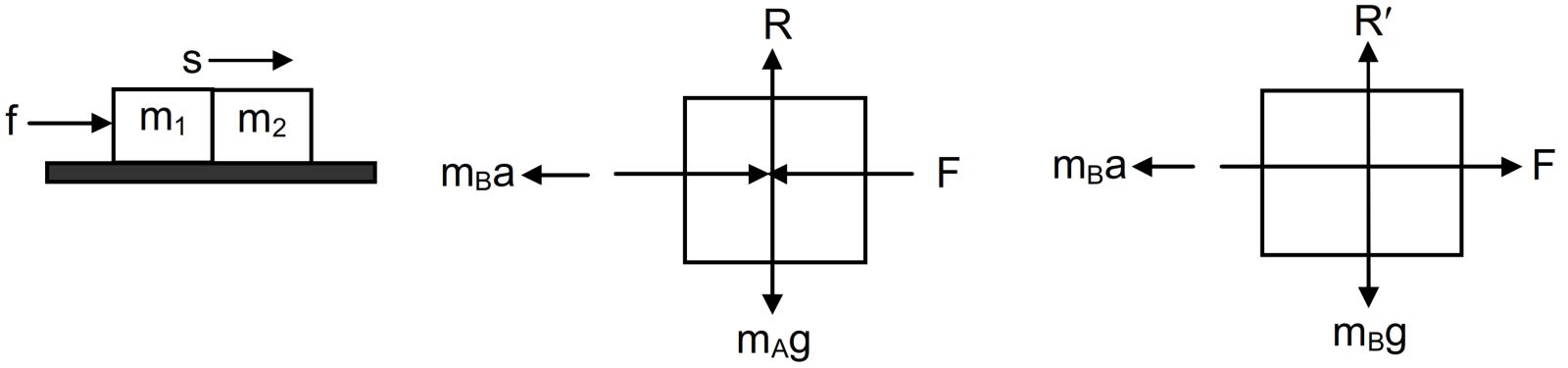
Answer

Let, F → contact force between $m_A$ & $m_B$. And, f → force exerted by experimenter.

$\left.F+m_A a-f=0 m_B a-f=0 \Rightarrow F=f-m_A a \ldots \text {... } i\right) \Rightarrow F=m_B a \ldots \text {...(ii) From eqn. (i) and eqn. (ii) } \Rightarrow f-m_A a=m_B a \Rightarrow f=$
$m_B a+m_A a \Rightarrow f=a\left(m_A+m_B\right)$
$\Rightarrow\text{f}=\frac{\text{F}}{\text{m}_{\text{B}}}(\text{m}_{\text{B}}+\text{m}_{\text{A}})=\text{F}\Big(1+\frac{\text{m}_{\text{A}}}{\text{m}_{\text{B}}}\Big)$
$\Big[\text{because }\text{a}=\frac{\text{F}}{\text{m}_{\text{B}}}\Big]$
$\therefore$ The force exerted by the experimenter is $\text{F}\Big(1+\frac{\text{m}_{\text{A}}}{\text{m}_{\text{B}}}\Big)$

Need a full question paper?

Generate a complete, print-ready paper with questions like this in minutes — across 16+ boards, with answer keys.

Start Generating Free

Similar questions

If the value of each of the units of force and length is doubled, then how many times will the value of the unit of energy become?
The surface tension of water is 72 dyne/cm. Convert it in SI unit.
State the number of significant figures in the following: $2.64 \times 10^{24} \mathrm{~kg}$
What is the condition for there to be a difference in the lengths of a brass rod and an iron rod at all temperatures?
How does the viscosity of gases depend upon temperature?
The sign of work done by a force on a body is important to understand. State carefully if the following quantities are positive or negative: Work done by a man in lifting a bucket out of a well by means of a rope tied to the bucket.
Carts with rubber tyres are easier to ply than those with iron tyres. Explain.
A circular loop of radius $4.0\ cm$ is placed in a horizontal plane and carries an electric current of $5.0A$ in the clockwise direction as seen from above. Find the magnetic field:
  1. At a point $3.0\ cm$ above the centre of the loop.
  2. At a point $3.0\ cm$ below the centre of the loop.
Answer the following: Comets move around the sun in highly elliptical orbits. The gravitational force on the comet due to the sun is not normal to the comet’s velocity in general. Yet the work done by the gravitational force over every complete orbit of the comet is zero. Why?
A bullet of mass 20g enters into a fixed wooden block with a speed of $40ms^{-1}$ and stops in it. Find the change in internal energy during the process.