MCQ
Two capacitances of capacity $C_1$ and $C_2$ are connected in series and potential difference V is applied across it. Then the potential difference across $C_1$ will be
  • A
    ${V} \frac{C_2}{C_1}$
  • B
    $V \frac{C_1+C_2}{C_1}$
  • $V \frac{C_2}{C_1+C_2}$
  • D
    $V \frac{C_1}{C_1+C_2}$

Answer

Correct option: C.
$V \frac{C_2}{C_1+C_2}$
(c) $V \frac{C_2}{C_1+C_2}$

Need a full question paper?

Generate a complete, print-ready paper with questions like this in minutes — across 16+ boards, with answer keys.

Start Generating Free

Similar questions

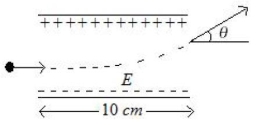
A uniform electric field of $10\,N / C$ is created between two parallel charged plates (as shown in figure). An electron enters the field symmetrically between the plates with a kinetic energy $0.5\,eV$. The length of each plate is $10\,cm$. The angle $(\theta)$ of deviation of the path of electron as it comes out of the field is  $.........$(in degree).
A long wire carries a steady current. It is bent into a circle of one turn and the magnetic field at the centre of the coil is $B$. It is then bent into a circular loop of $n$ $turns$. The magnetic field at the centre of the coil will be
The self inductance of a coil is 5 henry, a current of 1 amp change to 2 amp within 5 second through the coil. The value of induced e.m.f. will be
A charged particle is projected in a plane perpendicular to a uniform magnetic field. The area bounded by the path described by the particle is proportional to
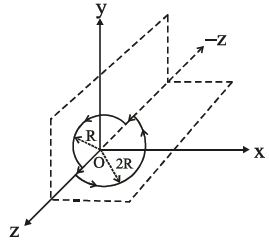
In given diagram, two current carrying circular loop of radius $R$ and $2R$ are arranged in $YZ-$ plane and $XZ-$ plane respectively. Common centre of both are at origin $O$. Then what will be angle of resultant magnetic field from $X-$ axis.
Five balls numbered 1 to 5 are suspended using separate threads. Pairs (1, 2), (2, 4) and (4, 1) show electrostatic attraction, while pair (2, 3) and (4, 5) show repulsion. Therefore ball 1 must be
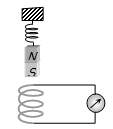
A magnet NS is suspended from a spring and while it oscillates, the magnet moves in and out of the coil C. The coil is connected to a galvanometer G. Then as the magnet oscillates,
Assume you are sitting in sun for $2.5$ hours. The area of your body exposed normally to sun rays $1.3 m^2$. The intensity of sun rays is $\frac{1.1 \text { Kilowatt }}{ m ^2}$ If your body completely absorbs the sun rays then the momentum transferred to your body will be $($in $Kg -\frac{ m }{ s } ):$
Two identical point charges are placed at a separation of $d$. $P$ is a point on the line joining the charges, at a distance $x$ from any one charge. The field at $P$ is $E$, $E$ is plotted against $x$ for values of $x$ from close to zero to slightly less than $d$. Which of the following represents the resulting curve
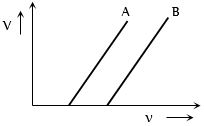
The stopping potential as a function of the frequency of the incident radiation is plotted for two different photoelectric surfaces $A$ and $B$. The graphs show that work function of $A$ is