Question
Two capillary tubes of same diameter are put vertically one each in two liquids whose relative densities are $0.8$ and $0.6$ and surface tensions are $60$ and $50$ dyne/cm respectively Ratio of heights of liquids in the two tubes $\frac{{{h_1}}}{{{h_2}}}$ is

Answer

(d) Ascent formula $h = \frac{{2T\cos \theta }}{{rdg}}$ 

$ \Rightarrow \frac{{{h_1}}}{{{h_2}}} = \frac{{{T_1}}}{{{T_2}}} \times \;\frac{{{d_2}}}{{{d_1}}}$          ($r,\;\theta $ and $g$ are constants) 

$ \Rightarrow \frac{{{h_1}}}{{{h_2}}} = \frac{{60}}{{50}} \times \frac{{0.6}}{{0.8}} = \frac{9}{{10}}$

Need a full question paper?

Generate a complete, print-ready paper with questions like this in minutes — across 16+ boards, with answer keys.

Start Generating Free

Similar questions

A particle of mass $\mathrm{m}$ is fixed to one end of a light spring having force constant $\mathrm{k}$ and unstretched length $\ell .$ The other end is fixed. The system is given an angular speed $\omega$ about the fixed end of the spring such that it rotates in a circle in gravity free space. Then the stretch in the spring is
The minimum frequency $\nu $ of continuous $X-$ rays is related to the applied potential difference $V$ as
A man sets his watch by a whistle that is $2\, km$ away. How much will his watch be in error. (speed of sound in air $330\, m/sec$)
$A$ uniform disc is rolling on a horizontal surface. At a certain instant $B$ is the point of contact and $A$ is at height $2R$ from ground, where $R$ is radius of disc.
Given below are two statements :

$Statement$ $(I)$ : Planck's constant and angular momentum have same dimensions.

$Statement$ $(II)$ : Linear momentum and moment of force have same dimensions.

In the light of the above statements, choose the correct answer from the options given below :

The incident ray, reflected ray and the outward drawn normal are denoted by the unit vectors $\overrightarrow{ a }, \overrightarrow{ b }$ and $\overrightarrow{ c }$ respectively. Then choose the correct relation for these vectors.
A simple pendulum, suspended from the ceiling of a stationary van, has time period $T$. If the van starts moving with a uniform velocity the period of the pendulum will be
A square shaped wire with resistance of each side $3\, \Omega$ is bent to form a complete circle. The resistance between two diametrically opposite points of the circle in unit of $\Omega$ will be ......
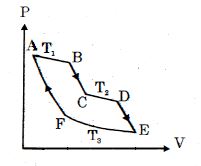
One mole of ideal gas taken through a cycle process with alternate isothermal and adiabatic curves. In $P-V$ diagram $AB, CD, EF$ are isothermal curves at the absolute temperature $T_1, T_2$ and $T_3$ respectively and $BC, DE$ and $FA$ are adiabatic curves respectively. If $\frac{{{V_B}}}{{{V_A}}} = 2,\,\frac{{{V_D}}}{{{V_C}}} = 2$ then for cycle is shown in figure four statements are being made given below. (Figure is not drawn on scale) 

Statement $1$ : Ratio of volumes $\frac{{{V_E}}}{{{V_F}}} = 4$

Statement $2$ : Magnitude of work done in isothermal compression $EF$ is $2RT_3\ ln\ (2)$

Statement $3$ : Ratio of heat supplied to gas in the process $AB$ to heat rejected by gas in process $EF$ is $\frac{{{T_1}}}{{2{T_3}}}$

Statement $4$ : Net work done by gas in the cycle $ABCDEFA$ is $(T_1 + T_2 - 2T_3) R\  ln\ (2)$ 

Find the number of correct statement $(s)$ given for the cyclic process followed by gas

If the change in the value of $‘g’$ at a height $h$ above the surface of the earth is the same as at a depth $x$ below it, then (both $x$ and $h$ being much smaller than the radius of the earth)