MCQ
Two cars of masses $m_1$ and $m_2$ are moving in circles of radii $r_1$ and $r_2$, respectively. Their speeds are such that they make complete circles in the same time $t$. The ratio of their centripetal acceleration is
  • A
    $1 : 1$
  • B
    $m_1 r_1 : m_2 r_2$
  • C
    $m_1 : m_2$
  • $r_1 : r_2$

Answer

Correct option: D.
$r_1 : r_2$
d
Both have same time period.

$\frac{\omega^{2} r_{1}}{\omega^{2} r_{2}}=\frac{r_{1}}{r_{2}}$

Need a full question paper?

Generate a complete, print-ready paper with questions like this in minutes — across 16+ boards, with answer keys.

Start Generating Free

Similar questions

The position of a particle moving in the $xy-$ plane at any time $t$ is given by $x = (3t^2 -6t)\, metres$, $y = (t^2 -2t)\,metres$. Select the correct statement about the moving particle from the following
Aball of mass $m$ is released from Ainside $a$ smooth wedge of mass $m$ as shown in the figure. What is the speed of the wedge when the ball reaches point $B$ ?
Two wires are in unison. If the tension in one of the wires is increased by $2\%, 5$ beats are produced per second. The initial frequency of each wire is  .... $Hz$
A particle of mass $1 kg$ is subjected to a force which depends on the position as $\vec{F}=-k(x \hat{i}+y \hat{j}) kgms ^{-2}$ with $k=1 kgs ^{-2}$. At time $t=0$, the particle's position $\vec{r}=\left(\frac{1}{\sqrt{2}} \hat{i}+\sqrt{2} \hat{j}\right) m$ and its velocity $\vec{v}=\left(-\sqrt{2} \hat{i}+\sqrt{2} \hat{j}+\frac{2}{\pi} \hat{k}\right) m s^{-1}$. Let $v_x$ and $v_y$ denote the $x$ and the $y$ components of the particle's velocity, respectively. Ignore gravity. When $z=0.5 m$, the value of $\left(x v_y-y v_x\right)$ is. . . . . $m^2 s^{-1}$
What must be the lengths of steel and copper rods at $0^o C$ for the difference in their lengths to be $10\,cm$ at any common temperature? $(\alpha_{steel}=1.2 \times {10^{-5}} \;^o C^{-1})$ and $(\alpha_{copper} = 1.8 \times 10^{-5} \;^o C^{-1})$
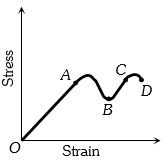
In the below graph, point $B$ indicates
Five masses each of $2\,kg$ are placed on a horizontal circular disc, which can be rotated about a vertical axis passing through its centre and all the masses be equidistant from the axis and at a distance of $10\,cm$ from it. The moment of inertia of the whole system (in $gm-cm^2$ ) is (Assume disc is of negligible mass)
A pendulum clock is set to give correct time at the sea level. This clock is moved to hill station at an altitude of $2500\, m$ above the sea level. In order to keep correct time of the hill station, the length of the pendulum
If $T$ is the surface tension of soap solution, the amount of work done in blowing a soap bubble from a diameter $D$ to $2D$ is
A $2 \,kg$ mass starts from rest on an inclined smooth surface with inclination $30^°$ and length $2\, m$. ...... $m$ will it travel before coming to rest on a frictional surface with frictional coefficient of $0.25$