MCQ
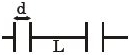
Two charged parallel plate capacitors, each with separation between plates equal to $d$, are separated by a large distance $L >> d$. Then the force of interaction between them is proportional to
  • A
    $1/{d^2}$
  • ${d^2}/{L^4}$
  • C
    $1/{d^3}$
  • D
    ${d^2}/{L^3}$

Answer

Correct option: B.
${d^2}/{L^4}$
b
For large separation capacitor can be treated as dipole and dipole moment $\propto$ $\mathrm{d}$

Force $\propto \frac{\mathrm{p}_{1} \mathrm{p}_{2}}{\mathrm{L}^{4}} \Rightarrow \mathrm{F} \propto \frac{\mathrm{d}^{2}}{\mathrm{L}^{4}}(\because \mathrm{p} \propto \mathrm{d})$

Need a full question paper?

Generate a complete, print-ready paper with questions like this in minutes — across 16+ boards, with answer keys.

Start Generating Free

Similar questions

What will be the nature of flow of water from a circular tap, when its flow rate increased from $0.18\, L / min$ to $0.48\, L / min$ ? The radius of the tap and viscosity of water are $0.5\, cm$ and $10^{-3}\, Pa s$, respectively.

(Density of water : $10^{3}\, kg / m ^{3}$ )

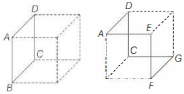
The current in flowing along the path $A B C D$ of a cube (shown in the left figure) produces a magnetic field at the centre of cube of magnitude $B$. Dashed line depicts the non-conducting part of the cube. Consider a cubical shape shown to the right which is identical in size and shape to the left. If the same current now flows in along the path $D A E F G C D$, then the magnitude of magnetic field at the centre will be
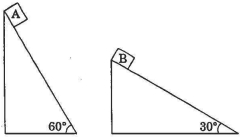
Two fixed frictionless inclined planes making an angle $30^\circ$ and $60^\circ$ with the vertical are shown in the figure. Two blocks $A$ and $B$ are placed on the two planes. What is the relative vertical acceleration of $A$ with respect to $B?$
For permanent magnet which of the following properties is must required 
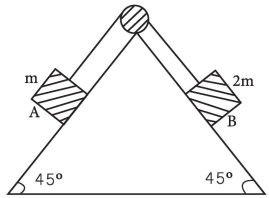
Consider the diagram shown below in which two masses of $m$ and $2 m$ are placed on a fixed triangular wedge. The coefficient of friction between block $A$ and the wedge is $2 / 3$, while that for block $B$ and the wedge is $1 / 3$
A vessel of volume 20L contains a mixture of hydrogen and helium at temperature of $27^{\circ} C$ and pressure $2 atm$. The mass of mixture is $5 g$. Assuming the gases to be ideal, the ratio of mass of hydrogen to that of helium in the given mixture will be
A steel scale measures the length of a copper wire as $80.0\,cm,$ when both are at $20^\circ C$ (the calibration temperature for scale). What would be the scale read for the length of the wire when both are at $40^\circ C$ $?$ (Given $\alpha_{steel} $ = $11 \times {10^{ - 6}}$per$°C$ and $\alpha_{copper}$  = $17 \times {10^{ - 6}}per\,^\circ C$)
An object of mass $'m'$ is being moved with a constant velocity under the action of an applied force of $2\, {N}$ along a frictionless surface with following surface profile.

The correct applied force vs distance graph will be:

A pen of mass $m$ is lying on a piece of paper of mass $M$ placed on a rough table. If the coefficients of friction between the pen and paper and the paper and the table are $\mu_1$ and $\mu_2$, respectively. Then, the minimum horizontal force with which the paper has to be pulled for the pen to start slipping is given by
A block of mass $100 \mathrm{~kg}$ slides over a distance of $10 \mathrm{~m}$ on a horizontal surface. If the co-efficient of friction between the surfaces is $0.4$ , then the work done against friction (in $\mathrm{J}$ ) is :