Question
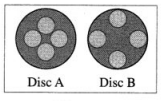
Two circular discs A and B, having the same mass, have four identical small circular discs placed on them, as shown in the diagram. They are simultaneously released from rest at the top of an inclined plane. If the discs roll down without slipping, which disc will reach the bottom first?
Image

Answer

The disc A has the smaller discs closer to the centre than disc B. Hence, the moment of inertia of disc $A\left(I_A\right)$ is less than that of disc $B\left(I_B\right)$.
[Suppose the larger discs have radius $R$, the smaller discs have mass $m$ and radius $r$, and the centre of each smaller disc on disc $\mathrm{A}$ is at a distance $\mathrm{x}$ from the centre. Then, $\mathrm{x}=\sqrt{2} \mathrm{rr}$ and, it can be shown that, $\left.I_B-I_A=4 m\left[R^2-(x-r)^2\right]>0.\right]$
Each composite disc is equivalent to a disc of the same radius $R$ and mass $M^{\prime}=M+4 m$, where $m$ is the mass of each smaller disc, but of different thicknesses.
Suppose, starting from rest, the composite discs roll down the same distance $L$ along a plane inclined at an angle $\theta$, their respective accelerations will be
$
a_{\mathrm{A}}=\frac{g \sin \theta}{1+\left(I_{\mathrm{A}} / M^{\prime} R^2\right)}, \quad a_{\mathrm{B}}=\frac{g \sin \theta}{1+\left(I_{\mathrm{B}} / M^{\prime} R^2\right)}
$
so that, the respective times taken to travel the distance $L$ are
$
\begin{aligned}
t_{\mathrm{A}} & =\sqrt{\frac{2 L}{a_{\mathrm{A}}}}=\sqrt{\frac{2 L}{g \sin \theta} \cdot\left(1+\frac{I_{\mathrm{A}}}{M^{\prime} R_2}\right)} \text { and } \\
t_{\mathrm{B}} & =\sqrt{\frac{2 L}{a_{\mathrm{B}}}}=\sqrt{\frac{2 L}{g \sin \theta} \cdot\left(1+\frac{I_{\mathrm{B}}}{M^{\prime} R_2}\right)} \\
\therefore t_{\mathrm{A}} & <t_{\mathrm{B}},
\end{aligned}
$
i.e., the disc A will reach the bottom first.

Need a full question paper?

Generate a complete, print-ready paper with questions like this in minutes — across 16+ boards, with answer keys.

Start Generating Free

Similar questions

Name two materials that have small and positive magnetic susceptibility.
In a potentiometer the balancing length of the wire is found to be \(2.5 m\) for a cell of e.m.f. \(1.5 V\). Find the balancing length of the wire for another cell of e.m.f. \(1.2 V\) on the same potentiometer.
Calculate the rise of water inside a clean glass capillary tube of radius $0.1 \ mm$, when immersed in water of surface tension $7 \times 10^{-2} N/m$. The angle of contact between water and glass is zero, the density of water $= 1000 kg/m^3, g = 9.8 m/s^2.$
The surface tension of water at \(0^{\circ} C\) is 75.5 dyne \(/ cm\). Find surface tension of water at \(25^{\circ} C\). [a for water \(=0.0021 /{ }^{\circ} C\) ]
An electron in hydrogen atom-stays in its second orbit for $10^{-8} s$. How many revolutions will it make around the nucleus in that time?
[Velocity of electron in second orbit $=1.07 \times 10^6 m / s$, radius of electron in second orbit $\left.=2.14 \times 10^{-10} m\right]$
Derive an expression for the work done during an isothermal process
Draw a p-V diagram showing positive work with varying pressure.
State any four Conditions for Obtaining well–defined and Steady Interference Patterns.
A string/wire is stretched between two rigid supports. State any two factors on which the fundamental frequency of the string/wire depends.
If the difference between the radii of the two spheres of a spherical capacitor is increased, state whether the capacitance will increase or decrease.