Question
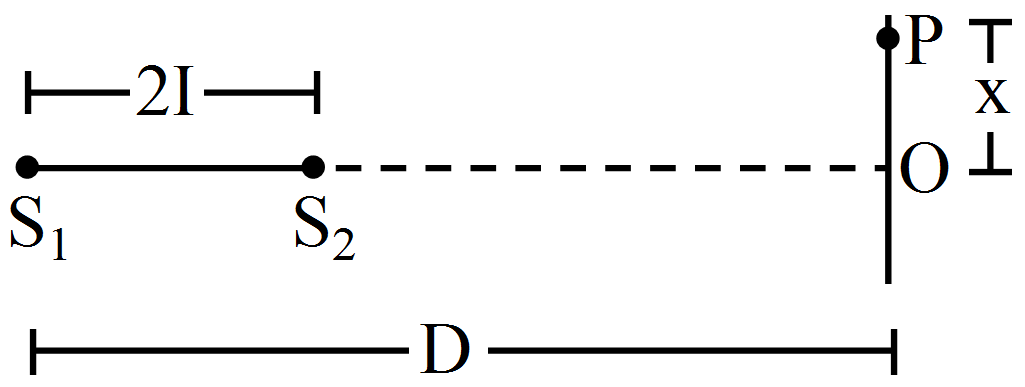
Two coherent narrow slits emitting sound of wavelength $\lambda$ in the same phase are placed parallel to each other at a small separation of $2\lambda.$ The sound is detected by moving a detector on the screen $\sum$ at a distance $\text{D}(>>\lambda)$ from the slit $S_1$ as shown in figure. Find the distance x such that the intensity at P is equal to the intensity at 0.
Answer

Given: $S_1$ & $S_2$ are in the same phase. At O, there will be maximum intensity. There will be maximum intensity at P. From the(in questions):$\triangle\text{S}_1\text{PO}$ and $\triangle\text{S}_2\text{PO}$ are right-angled triangle
So, $(\text{S}_1\text{P})^2-(\text{S}_2\text{P})^2$$=\big[\text{D}^2+\text{x}^2\big]-\Big[(\text{D}-2\lambda)^2+\text{x}^2\Big]^2$
$=4\lambda\text{D}+4\lambda^2=4\lambda\text{D}$
$\Big(\lambda^2$ is small and can be neglected$\Big)$
$\Rightarrow(\text{S}_1\text{P}+\text{S}_2\text{P})(\text{S}_1\text{P}-\text{S}_2\text{P})=4\lambda\text{D}$
$\Rightarrow(\text{S}_1\text{P}-\text{S}_2\text{P})=\frac{4\lambda\text{D}}{(\text{S}_1\text{P}+\text{S}_2\text{P})}$
$\Rightarrow\text{S}_1\text{P}-\text{S}_2\text{P}=\frac{4\lambda\text{D}}{2\sqrt{\text{x}^2+\text{D}^2}}$
For constructive interference, path difference $=\text{n}^\lambda$ So, $\text{S}_1\text{P}-\text{S}_2\text{P}=\frac{4\lambda\text{D}}{2\sqrt{\text{x}^2+\text{D}^2}}=\text{n}\lambda$$\Rightarrow\frac{2\text{D}}{\sqrt{\text{x}^2+\text{D}^2}}=\text{n}$
$\Rightarrow\text{n}^2\big(\text{x}^2+\text{D}^2\big)=4\text{D}^2$
$\Rightarrow\text{n}^2\text{x}^2+\text{n}^2\text{D}^2=4\text{D}^2$
$\Rightarrow\text{n}^2\text{x}^2=4\text{D}^2-\text{n}^2\text{D}^2$
$\Rightarrow\text{n}^2\text{x}^2=\text{D}^2(4-\text{n}^2)$
$\Rightarrow\text{x}=\frac{\text{D}}{\text{n}}\sqrt{4-\text{n}^2}$
When n = 1,$\text{x}=\sqrt{3}\text{D}$ ($1^{st}$ order).
When n = 2,$\text{x}=0$ ($2^{nd}​​​​​​​$ order).
So when $\text{x}=\sqrt{3}\text{D},$ the intensity at P is equal to the intensity at O.

Need a full question paper?

Generate a complete, print-ready paper with questions like this in minutes — across 16+ boards, with answer keys.

Start Generating Free

Similar questions

A particle of mass $10g$ is placed in a potential field given by $U = 50x^2 + 100 erg/gm$. Calculate the frequency of oscillation.
What is the direction of areal velocity of the earth around the sun?
For three moving objects the distances are found to be directly proportional to the times $t, t^2$ and $t^3$. What is the nature of the net force on each object?
Two parallel rail tracks run north-south. Train A moves due north with a speed of $54km/ h^{-1}$ and train B moves due south with a speed of $90km/ h^{-1}$. What is the relative velocity of B with respect to A in $m s^{-1}$?
A lawyer alleges in court that the police has forced his client to issue a statement of confession. What kind of force is this?
A wave pulse is travelling on a string with a speed $v$ towards the positive $X-$axis. The shape of the string at $t = 0$ is given by $\text{g(x)}=\text{A}\sin\big(\frac{\text{x}}{\text{a}}\big),$ where $A$ and $a$ are constants.
  1. What are the dimensions ot $A$ and $a$ ?
  2. Write the equation of the wave for a general time $t,$ if the wave speed is $v.$
Why does a solid sphere have smaller moment of inertia than a hollow cylinder of same mass and radius, about an axis passing through their axes of symmetry?
A particle located at x = 0 at time t = 0 starts moving along the positive x direction with a velocity v that varies as $\text{v}=\alpha\sqrt{\text{x}}.$ How do the displacement, velocity and acceleration of the particle vary with time? What is the average velocity of the particle over the first s metres of its path?
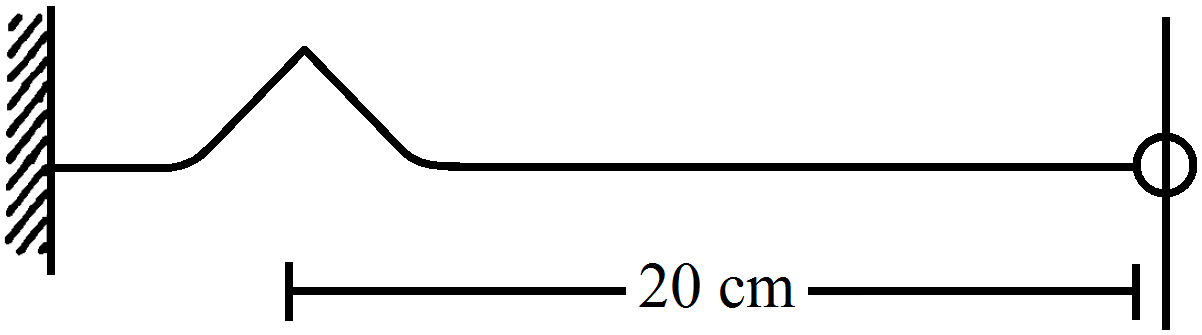
A string of linear mass density $0.5g/cm$ and a total length $30\ cm$ is tied to a fixed wall at one end and to a frictionless ring at the other end figure, The ring can move on a vertical rod. A wave pulse is produced on the string which moves towards the ring at a speed of $20\ cm/s.$ The pulse is symmetric about its maximum which is located at a distance of $20\ cm$ from the end joined to the ring.
  1. Assuming that the wave is reflected from the ends without loss of energy, find the time taken by the string to regain its shape.
  2. The shape of the string changes periodically with time. Find this time period.
  3. What is the tension in the string?
A particle is released from the top of an incline of height h. Does the kinetic energy of the particle at the bottom of the incline depend on the angle of incline? Do you need any more information to answer this question in Yes or No?