Question
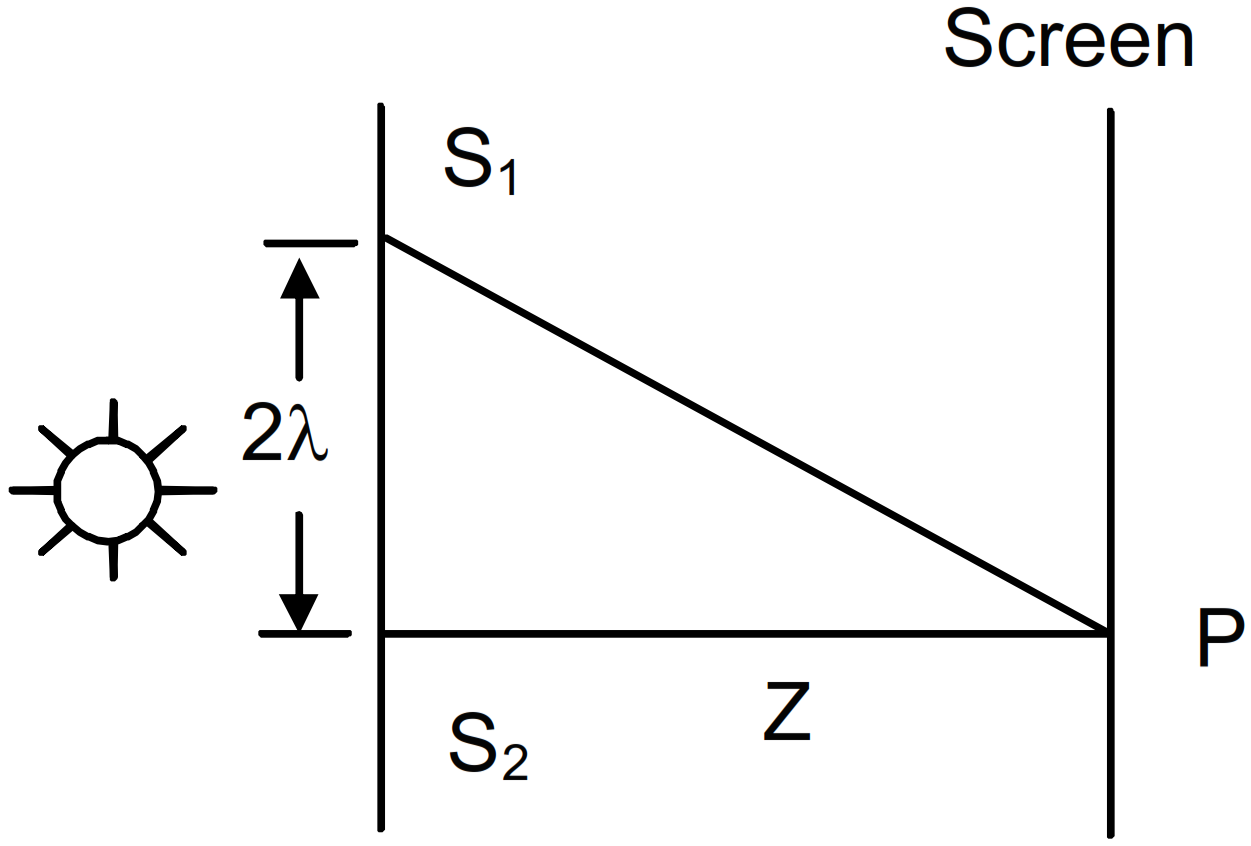
Two coherent point sources S1 and S2 vibrating in phase emit light of wavelength $\lambda$. The separation between the sources is $2\lambda$. Consider a line passing through S2 and perpendicular to the line S1S2. What is the smallest distance from S2 where a minimum of intensity occurs?
Answer

For minimum intensity

$\therefore\text{S}_1\text{P}-\text{S}_2\text{P}=\text{x}=(2\text{n}+1)\frac{\lambda}{2}$
From the figure, we get,
$\Rightarrow\sqrt{\text{X}^2+(2\lambda)^2}-\text{Z}=(2\text{n}+1)\frac{\lambda}{2}$
$\Rightarrow\text{Z}^2+4\lambda^2=\text{Z}^2+(2\text{n}+1)^2\frac{\lambda^2}{4}+\text{Z}(2\text{n}+1)\lambda$
$\Rightarrow\text{Z}=\frac{4\lambda^2-(2\text{n}+1)^2\Big(\lambda^2{4}\Big)}{(2\text{n}+1)\lambda}=\frac{16\lambda^2-(2\text{n}+1)^2\lambda^2}{4(2\text{n}+1)\lambda}\ ...(1)$
Putting, $\text{n}=0\Rightarrow\text{Z}=\frac{15\lambda}{4}$
$\text{n}=-1\Rightarrow\text{Z}=\frac{-15\lambda}{4}$
$\text{n}=1\Rightarrow\text{Z}=\frac{7\lambda}{12}$
$\text{n}=2\Rightarrow\text{Z}=\frac{-9\lambda}{20}$
$\therefore\text{Z}=\frac{7\lambda}{12}$ is the smallest distance for which there will be minimum intensity.

Need a full question paper?

Generate a complete, print-ready paper with questions like this in minutes — across 16+ boards, with answer keys.

Start Generating Free

Similar questions

Figure shows a square loop ABCD with edgelength a. The resistance of the wire ABC is r and that of ADC is 2r. Find the magnetic field B at the centre of the loop assuming uniform wires.

Two large conducting plates are placed parallel to each other with a separation of 2.00cm between them. An electron starting from rest near one of the plates reaches the other plate in 2.00 microseconds. Find the surface charge density on the inner surfaces.
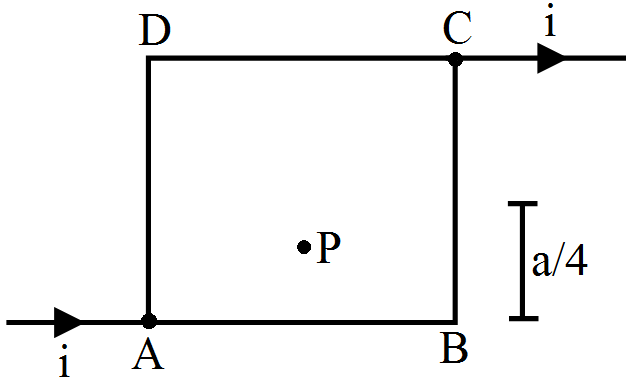
Figure shows a square loop of edge a made of a uniform wire. A current i enters the loop at the point A and leaves it at the point C. Find the magnetic field at the point P which is on the perpendicular bisector of AB at a distance $\frac{\text{a}}{4}$ from it.

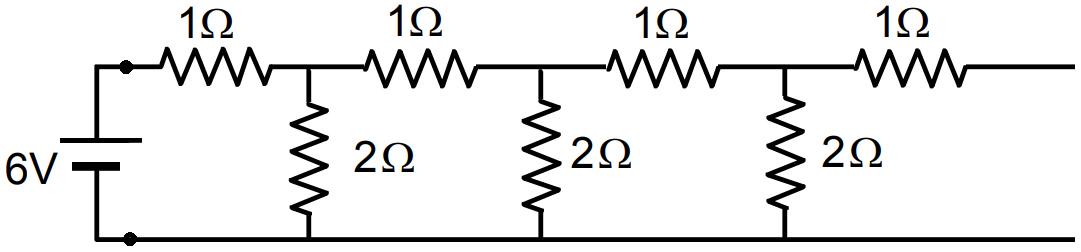
An infinite ladder is constructed with $1\Omega$ and $2\Omega$ resistors, as shown in the figure.

(a) Find the effective resistance between the points A and B. (b) Find the current that passes through the $2\Omega$ resistor nearest to the battery.

A spherical capacitor has an inner sphere of radius 12cm and an outer sphere of radius 13cm. The outer sphere is earthed and the inner sphere is given a charge of 2.5µC. The space between the concentric spheres is filled with a liquid of dielectric constant 32.
  1. Determine the capacitance of the capacitor.
  2. What is the potential of the inner sphere?
  3. Compare the capacitance of this capacitor with that of an isolated sphere of radius 12cm. Explain why the latter is much smaller.
What are N-type semiconductors? Their conductivity is higher than that of pure semiconductors. Why? Explain with figure.
Two particles A and B having charges q and 2q respectively are placed on a smooth table with a separation d. A third particle C is to be clamped on the table in such a way that the particles A and B remain at rest on the table under electrical forces. What should be the charge on C and where should it be clamped?
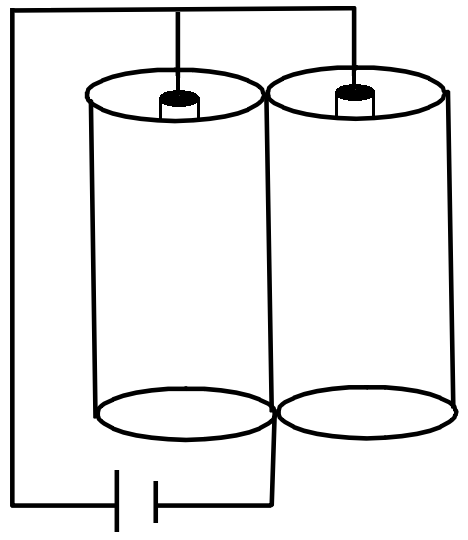
The outer cylinders of two cylindrical capacitors of capacitance $2.2\mu\text{F}$ each, are kept in contact and the inner cylinders are connected through a wire. A battery of emf 10V is connected as shown in figure. Find the total charge supplied by the battery to the inner cylinders.

The intensity of the sunlight reaching Earth is 1380Wm-2. Assume this light to be a plane, monochromatic wave. Find the amplitudes of electric and magnetic fields in this wave.
An ideal gas is trapped between a mercury column and the closed-end of a narrow vertical tube of uniform base containing the column. The upper end of the tube is open to the atmosphere. The atmospheric pressure equals 76cm of mercury. The lengths of the mercury column and the trapped air column are 20cm and 43cm respectively. What will be the length of the air column when the tube is tilted slowly in a vertical plane through an angle of 60°? Assume the temperature to remain constant.