Question

Two coherent sources of light can be obtained by

(a) Two different lamps

(b) Two different lamps but of the same power

(c) Two different lamps of same power and having the same colour

(d) None of the above

Answer

(d) None of the above

Need a full question paper?

Generate a complete, print-ready paper with questions like this in minutes — across 16+ boards, with answer keys.

Start Generating Free

Similar questions

Let V and H be the vertical and horizontal components of earth's magnetic field at any point on earth. Near the north pole

(a) V >> H

(b) V << H

(c) V = H  

(d) V = H = 0

 and  are the electrical conductivities of Ge and Na respectively. If these substances are heated, then

(a) Both    and  increase

(b)   increases and   decreases

(c)   decreases and  increases

(d) Both   and  decrease

1C is the charge which is placed at a distance of 1m from the another charge of same magnitude in vacuum experiences an electrical force of repulsion of magnitude:

A potentiometer consists of a wire of length 4 m and resistance 10 W. It is connected to cell of emf 2 V. The potential difference per unit length of the wire will be

(a) 0.5 V/m

(b) 10 V/m

(c) 2 V/m

(d) 5 V/m

A point charge q is rotated along a circle in the electric field generated by another point charge Q. The work done by the electric field on the rotating charge in one complete revolution is_______?
Electromagnetic induction is the:

A torch bulb rated as 4.5 W, 1.5 V is connected as shown in the figure. The e.m.f. of the cell needed to make the bulb glow at full intensity is

(a) 4.5 V

(b) 1.5 V

(c) 2.67 V

(d) 13.5 V

Diffusion current in a p-n junction is greater than the drift current in magnitude:
  1. If the junction is forward-biased.
  2. If the junction is reverse-biased.
  3. If the junction is unbiased.
  4. In no case.

If the operating potential of an X-ray tube is 50 kV, the velocity of X-rays coming out of it is

(a) 4  

(b) 3  

(c)  

(d) 3 m/s

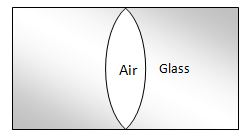
In the figure, an air lens of radii of curvature 10 cm (= 10 cm) is cut in a cylinder of glass (μ = 1.5). The focal length and the nature of the lens is

(a) 15 cm, concave

(b) 15 cm, convex

(c) , neither concave nor convex

(d) 0, concave