Question
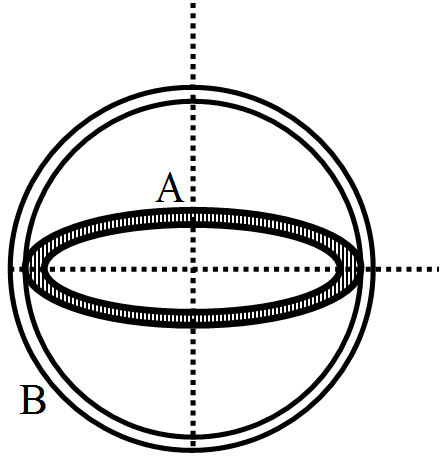
Two coils of wire A and B are placed mutually perpendicular as shown in figure. When current is changed in any one coil, will the current induce in another coil?
Answer

No, this is because the magnetic field due to current in coil (A or B) will be parallel to the plane of the other coil (A or B) Hence, the magnetic flux linked with the other coil will be zero and so no current will be induced in it.

Need a full question paper?

Generate a complete, print-ready paper with questions like this in minutes — across 16+ boards, with answer keys.
Start Generating Free

Similar questions

In 1959 Lyttleton and Bondi suggested that the expansion of the Universe could be explained if matter carried a net charge. Suppose that the Universe is made up of hydrogen atoms with a number density N, which is maintained a constant. Let the charge on the proton be: $e_p= -(1 + y)e$ where e is the electronic charge.
Show that the velocity of expansion is proportional to the distance from the centre.
A Galilean telescope is 27cm long when focused to form an image at infinity. If the objective has a focal length of 30cm, what is the focal length of the eyepiece?
Why is exposure to X-rays injurious to health but not exposure to visible light, when both are electromagnetic waves?
Answer the following questions:
A steady current flows in a metallic conductor of non-uniform cross-section. Which of these quantities is constant along the conductor: current, current density, electric field, drift speed?
A constant volume thermometer registers a pressure of $1.500 \times 10^4Pa$ at the triple point of water and a pressure of $2.050 \times 10^4Pa $ at the normal boiling point. What is the temperature at the normal boiling point?
  1. Write two main observations of photoelectric effect experiment which could only be explained by Einstein’s photoelectric equation.
  2. Draw a graph showing variation of photocurrent with the anode potential of a photocell.
A galvanometer has a resistance of $8 \Omega$ . It gives a full scale deflection for a current of $10 \ mA.$ It is to be converted into an ammeter of range $5 A.$ The only shunt resistance available is of $0.02 \Omega$ , which is not suitable for this conversion. Find the value of resistance $R$ that must be connected in series with the galvanometer $($Fig$.)$ to get ammeter of desired range.
Image
If work function of the metal is $3.31 \times 1.6 \times$ $10^{-19}$ Joule, then calculate its threshold frequency in hertz.
Explain electric field produced by the point electric charge.
How does the conductivity of semiconductors increase with increasing temperature?