Question
Two conducting plates X and Y, each having large surface area A (on one side), are placed parallel to each other as shown in figure. The plate X is given a charge Q whereas the other is neutral. Find:
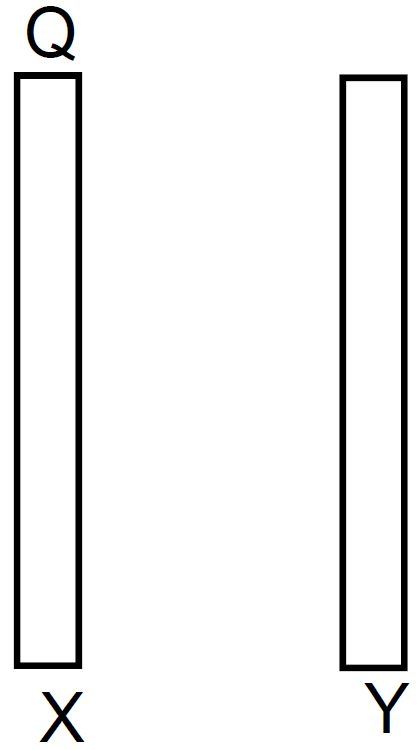
  1. The surface charge density at the inner surface of the plate X.
  2. The electric field at a point to the left of the plates.
  3. The electric field at a point in between the plates.
  4. The electric field at a point to the right of the plates.
Answer

  1. Given that the charge present on the plate is Q. The other plate will get the same charge Q due to convection.
Let the surface charge densities on both sides of the plate be $\sigma_1$ and $\sigma_2.$

Now, electric field due to a plate,

$\text{E}=\frac{\sigma}{2\in_0}$

So, the magnitudes of the electric fields due to this plate on each side $=\frac{\sigma_1}{2\in_0}$ and $\frac{\sigma_2}{2\in_0}$

The plate has two sides, each of area A. So, the net charge given to the plate will be equally distributed on both the sides.This implies that the charge developed on each side will be:

$\text{q}_1=\text{q}_2=\frac{\text{Q}}{2}$

This implies that the net surface charge density on each side $=\frac{\text{Q}}{2\text{A}}$
  1. Electric field to the left of the plates
On the left side of the plate surface, charge density,

$\sigma=\frac{\text{Q}}{2\text{A}}$

Hence, electric field $=\frac{\text{Q}}{2\text{A}\in_0}$

This must be directed towards the left, as 'X' is the positively-charged plate.
  1. Here, the charged plate 'X' acts as the only source of electric field, with positive in the inner side. Plate Y is neutral. So, a negative charge will be induced on its inner side. 'Y' attracts the charged particle towards itself. So, the middle portion E is towards the right and is equal to $\frac{\text{Q}}{2\text{A}\in_0}.$
  2. Similarly for the extreme right, the outer side of plate 'Y' acts as positive and hence it repels to the right with $\text{E}=\frac{\text{Q}}{2\text{A}\in_0}.$

Need a full question paper?

Generate a complete, print-ready paper with questions like this in minutes — across 16+ boards, with answer keys.

Start Generating Free

Similar questions

One day in the morning, Ramesh filled up 1/ 3 bucket of hot water from geyser, to take bath. Remaining 2/ 3 was to be filled by cold water (at room temperature) to bring mixture to a comfortable temperature. Suddenly Ramesh had to attend to something which would take some times, say 5-10 minutes before he could take bath. Now he had two options:
  1. Fill the remaining bucket completely by cold water and then attend to the work.
  2. First attend to the work and fill the remaining bucket just before taking bath. Which option do you think would have kept water warmer? Explain.
A metal rod of cross sectional area $1.0 \mathrm{~cm}^2$ is being heated at one end. At one time, the temperature gradient is $5.0^{\circ} \mathrm{C} / \mathrm{cm}^{-1}$ at cross section A and is $2.5^{\circ} \mathrm{C} / \mathrm{cm}^{-1}$ at cross section B . Calculate the rate at which the temperature is increasing in the part $A B$ of the rod. The heat capacity of the part $A B=0.40 \rho^{\circ} \mathrm{C}^{-1}$, thermal conductivity of the material of the rod $=200 \mathrm{Wm}^{-1} \mathrm{C}^{-1}$. Neglect any loss of heat to the atmosphere.
A battery of emf 100V and a resistor of resistance $10\text{k}\Omega$ are joined in series. This system is used as a source to supply current to an external resistance R. If R is not greater than $100\Omega,$ the current through it is constant up to two significant digits. Find its value. This is the basic principle of a constant-current source.
Estimate the average thermal energy of a helium atom at:
  1. Room temperature $(27°C)$
  2. The temperature on the surface of the Sun$(6000K)$
  3. The temperature of $10$ million kelvin (the typical core temperature in the case of a star).
A ball is dropped from a height of $5m$ onto a sandy floor and penetrates the sand up to $10cm$ before coming to rest. Find the retardation of the ball in sand assuming it to be uniform.
The electric field associated with a light wave is given by $\text{E}=\text{E}_0\sin[(1.57\times10^7\text{m}^{-1})(\text{x}-{\text{ct}})].$ Find the stopping potential when this light is used in an experiment on photoelectric effect with the emitter having work function 1.9eV.
Discuss the various factors influencing velocity of sound. A sonometer wire of length $110cm$ is stretched with a tension T and fixed at its ends. The wire is divided into three segments by placing two bridges below it. Where should the bridges be placed so that the fundamental frequencies of the segments are in the ratio $1: 2: 3$?
Two mercury droplets of radii $0.1cm$. and $0.2cm$. collapse into one single drop. What amount of energy is released? The surface tension of mercury $T = 435.5 \times 10^{-3}N m^{-1}$
A plane electromagnetic wave is passing through a region. Consider (a) electric field (b) magnetic field (c) electrical energy in a small volume and (d) magnetic energy in a small volume. Construct the pairs of the quantities that oscillate with equal frequencies.
Sometimes we show an idealised magnetic field which is uniform in a given region and falls to zero abruptly. One such field is represented in figure. Using Ampere's law over the path PQRS, show that such a field is not possible.