Question
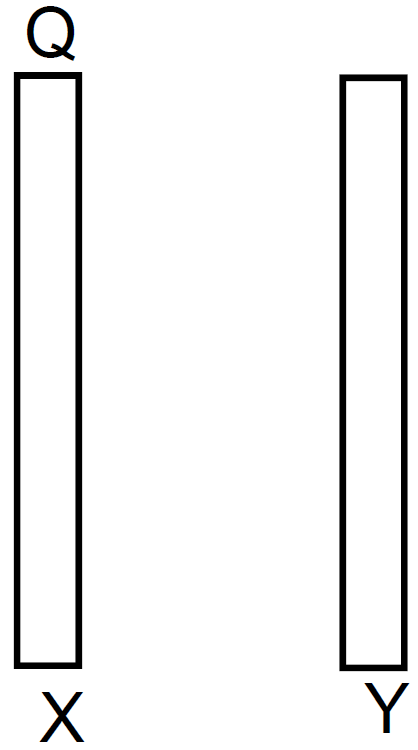
Two conducting plates X and Y, each having large surface area A (on one side), are placed parallel to each other as shown in figure. The plate X is given a charge Q whereas the other is neutral. Find:

  1. The surface charge density at the inner surface of the plate X.
  2. The electric field at a point to the left of the plates.
  3. The electric field at a point in between the plates.
  4. The electric field at a point to the right of the plates.

Answer

  1. Given that the charge present on the plate is Q. The other plate will get the same charge Q due to convection.

Let the surface charge densities on both sides of the plate be $\sigma_1$ and $\sigma_2.$

Now, electric field due to a plate,

$\text{E}=\frac{\sigma}{2\in_0}$

So, the magnitudes of the electric fields due to this plate on each side $=\frac{\sigma_1}{2\in_0}$ and $\frac{\sigma_2}{2\in_0}$

The plate has two sides, each of area A. So, the net charge given to the plate will be equally distributed on both the sides.This implies that the charge developed on each side will be:

$\text{q}_1=\text{q}_2=\frac{\text{Q}}{2}$

This implies that the net surface charge density on each side $=\frac{\text{Q}}{2\text{A}}$

  1. Electric field to the left of the plates

On the left side of the plate surface, charge density,

$\sigma=\frac{\text{Q}}{2\text{A}}$

Hence, electric field $=\frac{\text{Q}}{2\text{A}\in_0}$

This must be directed towards the left, as 'X' is the positively-charged plate.

  1. Here, the charged plate 'X' acts as the only source of electric field, with positive in the inner side. Plate Y is neutral. So, a negative charge will be induced on its inner side. 'Y' attracts the charged particle towards itself. So, the middle portion E is towards the right and is equal to $\frac{\text{Q}}{2\text{A}\in_0}.$
  2. Similarly for the extreme right, the outer side of plate 'Y' acts as positive and hence it repels to the right with $\text{E}=\frac{\text{Q}}{2\text{A}\in_0}.$
Need a full question paper?

Generate a complete, print-ready paper with questions like this in minutes — across 16+ boards, with answer keys.

Start Generating Free

Similar questions

A capacitor having a capacitance of $100\mu\text{F}$ is charged to a potential difference of 24V. The charging battery is disconnected and the capacitor is connected to another battery of emf 12V with the positive plate of the capacitor joined with the positive terminal of the battery:
  1. Find the charges on the capacitor before and after the reconnection.
  2. Find the charge flown through the 12V battery.
  3. Is work done by the battery or is it done on the battery? Find its magnitude.
  4. Find the decrease in electrostatic field energy.
  5. Find the heat developed during the flow of charge after reconnection.
If the nucleons of a nucleus are separated from each other, the total mass is increased. Where does this mass come from?
Estimate the average thermal energy of a helium atom at:
  1. Room temperature (27°C)
  2. The temperature on the surface of the Sun(6000K)
  3. The temperature of 10 million kelvin (the typical core temperature in the case of a star).
The motion of a particle executing simple harmonic motion is described by the displacement function,

$\text{x(t)}=\text{A}\cos(\omega\text{t}+\phi).$

If the initial (t = 0) position of the particle is 1cm and its initial velocity is $\omega\text{ cm/s,}$ what are its amplitude and initial phase angle? The angular frequency of the particle is $\pi\text{s}^{-1}.$ If instead of the cosine function, we choose the sine function to describe the SHM: $\text{x}=\text{B}\sin(\omega\text{t}+\alpha),$ what are the amplitude and initial phase of the particle with the above initial conditions.

The conductivity of an intrinsic samiconductor depends on temperature as $\sigma=\sigma_0\text{ e}^{\frac{-\Delta\text{E}}{2\text{kT}}}$ where $\sigma_0$ is a constant. Find the temperature at which the conductivity pf an intrinsic germanium semiconductor will be double of its value at T = 300K. Assume that the gap for germanium is 0.650eV and remains constant as the temperature is increased.
Mathematically describe the motion of a particle along a plane (or along a two-dimensional plane).
When a system is taken from state i to state f along the path iaf (see fig. below), it is found that the heat Q absorbed by the system is 50 cal. and work done W by the system is equal to 20 cal. along the path ibf; Q = 36 cal.
  1. What is W along the path ibf?
  2. If W = -13 cal. for the curved return path fi, what is for this path?
  3. Take Ui = 10 cal, what is Uf?
  4. If Ub = 22 cal. what are Q for the processes bf and ib?
​​​​​​​
A bat is flitting about in a cave, navigating via ultrasonic beeps. Assume that the sound emission frequency of the bat is 40 kHz. During one fast swoop directly toward a flat wall surface, the bat is moving at 0.03 times the speed of sound in air. What frequency does the bat hear reflected off the wall?
Find the total heat produced in the loop of the previous problem during the interval 0 to 30s if the resistance of the loop is $4.5\text{m}\Omega.$
Find the expression of pressure at any point inside the liquid and prove that $P \propto$ h. If the atmospheric pressure on the free surface of the liquid is Pa then find the total pressure on depth h from the free surface of the liquid.