Question
Two conducting plates X and Y, each having large surface area A (on one side), are placed parallel to each other as shown in figure. The plate X is given a charge Q whereas the other is neutral. Find:
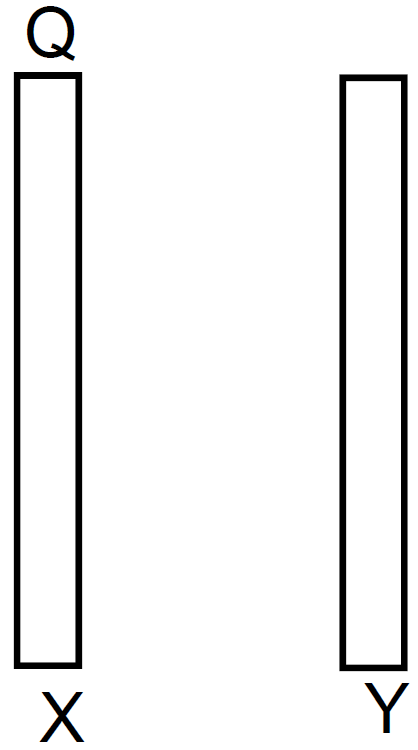
  1. The surface charge density at the inner surface of the plate X.
  2. The electric field at a point to the left of the plates.
  3. The electric field at a point in between the plates.
  4. The electric field at a point to the right of the plates.
Answer

  1. Given that the charge present on the plate is Q. The other plate will get the same charge Q due to convection.
Let the surface charge densities on both sides of the plate be $\sigma_1$ and $\sigma_2.$

Now, electric field due to a plate,

$\text{E}=\frac{\sigma}{2\in_0}$

So, the magnitudes of the electric fields due to this plate on each side $=\frac{\sigma_1}{2\in_0}$ and $\frac{\sigma_2}{2\in_0}$

The plate has two sides, each of area A. So, the net charge given to the plate will be equally distributed on both the sides.This implies that the charge developed on each side will be:

$\text{q}_1=\text{q}_2=\frac{\text{Q}}{2}$

This implies that the net surface charge density on each side $=\frac{\text{Q}}{2\text{A}}$
  1. Electric field to the left of the plates
On the left side of the plate surface, charge density,

$\sigma=\frac{\text{Q}}{2\text{A}}$

Hence, electric field $=\frac{\text{Q}}{2\text{A}\in_0}$

This must be directed towards the left, as 'X' is the positively-charged plate.
  1. Here, the charged plate 'X' acts as the only source of electric field, with positive in the inner side. Plate Y is neutral. So, a negative charge will be induced on its inner side. 'Y' attracts the charged particle towards itself. So, the middle portion E is towards the right and is equal to $\frac{\text{Q}}{2\text{A}\in_0}.$
  2. Similarly for the extreme right, the outer side of plate 'Y' acts as positive and hence it repels to the right with $\text{E}=\frac{\text{Q}}{2\text{A}\in_0}.$

Need a full question paper?

Generate a complete, print-ready paper with questions like this in minutes — across 16+ boards, with answer keys.

Start Generating Free

Similar questions

A particle A with a mass $m_A$ is moving with a velocity v and hits a particle $B ($mass $m_B) $ at rest (one dimensional motion). Find the change in the de Broglic wavelength of the particle A. Treat the collision as elastic.
An optical instrument used for angular magnification has a 25D objective and a 20D eyepiece. The tube length is 25cm when the eye is least strained.
  1. Whether it is a microscope or a telescope?
  2. What is the angular magnification produced?
A capacitor of capacitance $12.0\mu\text{F}$ is connected to a battery of emf 6.00V and internal resistance $1.00\Omega$ through resistanceless leads. $12.0\mu\text{s}$ after the connections are made, what will be (a) the current in the circuit (b) the power delivered by the battery (c) the power dissipated in heat and (d) the rate at which the energy stored in the capacitor is increasing.
Particles of masses 1g, 2g, 3g, ........, 100g are kept at the marks 1cm, 2cm, 3cm, ........, 100cm respectively on a metre scale. Find the moment of inertia of the system of particles about a perpendicular bisector of the metre scale.
In a Young's double slit experiment using monochromatic light, the fringe pattern shifts by a certain distance on the screen when a mica sheet of refractive index 1.6 and thickness 1.964 micron $(1$ micron $= 10^{-6}m)$ is introduced in the path of one of the interfering waves. The mica sheet is then removed and the distance between the screen and the slits is doubled. It is found that the distance between the successive maxima now is the same as the observed fringe-shift upon the introduction of the mica sheet. Calculate the wavelength of the monochromatic light used in the experiment.
An icebox almost completely filled with ice at 0°C is dipped into a large volume of water at 20°C. The box has walls of surface area $2400cm^2,$ thickness 2.0mm and thermal conductivity $0.06\text{Wm}^{-1}{^{\circ}}\text{C}^{-1}.$ Calculate the rate at which the ice melts in the box. Latent heat of fusion of ice $= 3.4\times10^5\text{Jkg}^{-1}.$
A compound microscope consists of an objective of focal length 1cm and an eyepiece of focal length 5cm. An object is placed at a distance of 0.5cm from the objective. What should be the separation between the lenses so that the microscope projects an inverted real image of the object on a screen 30cm behind the eyepiece?
Two small balls, each of mass m are connected by a light rigid rod of length L. The system is suspended from its centre by a thin wire of torsional constant k. The rod is rotated about the wire through an angle $\theta_0$ and released. Find the tension in the rod' as the system passes through the mean position.
The first four spectral lines in the Lyman serics of a H-atom are λ = 1218Å, 1028Å, 974.3Å and 951.4Å. If instead of Hydrogen, we consider Deuterium, calculate the shift in the wavelength of these lines.
A $5.0\mu\text{F}$ capacitor is charged to 12V. The positive plate of this capacitor is now connected to the negative terminal of a 12V battery and vice versa. Calculate the heat developed in the connecting wires.