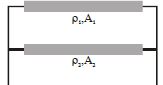
Two conductors of same length are connected in parallel as shown in figure. Their cross-sectional areas $A_1$ and $A_2$ and their resistivities are ${\rho _1}$ and ${\rho _2}$ respectively. The equivalent resistivity of this combination is
Medium


Download our appand get started for free
Experience the future of education. Simply download our apps or reach out to us for more information. Let's shape the future of learning together!No signup needed.*
Similar Questions
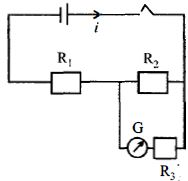
- 1To find the resistance of a galvanometer by the half deflection method the following circuit is used with resistances $R_1 = 9970\,\Omega,$ $R_2 = 30\,\Omega$ and $R_3 = 0\,\Omega.$ The deflection in the galvanometer is $d$. With $R_3 = 107\,\Omega$ the deflection changed to $\frac {d}{2}$The galvanometer resistance is approximately ............... $\Omega$View Solution
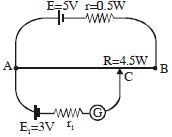
- 2In the given potentiometer circuit length of the wire $AB$ is $3\,m$ and resistance is $R=4.5\,\Omega $. The length $AC$ for no deflection in galvanometer is ............... $m$View Solution
- 3A solenoid is at potential difference $60\, V$ and current flows through it is $15$ ampere, then the resistance of coil will be ............ $\Omega$View Solution
- 4View SolutionIf an electric current is passed through a nerve of a man, then man
- 5View SolutionIn a metallic conductor, under the effect of applied electric field, the free electrons of the conductor
- 6An electrical bulb rated $220\,V , 100\,W$, is connected in series with another bulb rated $220\,V$, $60\,W$.If the voltage across combination is $220\,V$, the power consumed by the $100\,W$ bulb will be about $........... W$View Solution
- 7Consider a metallic cube of edge length $L$. Its resistance, $R$, measured across its opposite faces is $R =\frac{ m _{ e } v }{ ne ^2 L ^2}$, where $n$ is the number density and $v$ is the drift speed of electrons in the cube, and $e$ and $m _{ e }$ are the charge and mass of an electron respectively. Assuming the de-Broglie wavelength of the electron to be $L$, the maximum resistance of the sample is closest to ............. $\,\Omega$ $\left(e=1.60 \times 10^{-19} \,C ; m _{ e }=9.11 \times 10^{-31} \,kg\right.$; Planck's constant, $h=6.63 \times 10^{-34} \,Js$ )View Solution
- 8View SolutionOhm's law fails in
- 9$20\,\mu A$ current flows for $30$ seconds in a wire, transfer of charge will beView Solution
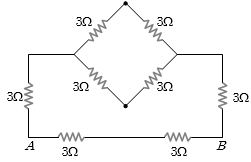
- 10Equivalent resistance between $A$ and $B$ will be ............ $ohm$View Solution