MCQ
Two current carrying loops of same area but of different materials have same current flowing in them in anti$-$clockwise direction. if a magnetic field is applied in upward direction then potential energy of loop $1$ and loop $2$ will always be:
  • A
    Different
  • Equal
  • C
    Can be different or equal depend upon material
  • D
    Can't say

Answer

Correct option: B.
Equal
potential energy in magnetic feild is given by $U = \mu B \sin \ \theta $ Two current carrying loops of same area but of different materials have same current flowing in them in anti$-$clockwise direction.if a magnetic field is applied in upward direction then potential energy of loop $1$ and loop $2$ will always be Equal.

Need a full question paper?

Generate a complete, print-ready paper with questions like this in minutes — across 16+ boards, with answer keys.

Start Generating Free

Similar questions

An electric dipole with dipole moment $\vec p = (3i + 4j) \times 10^{-30} C-m$ is placed in an electric field $\vec E = 4000 \hat i (N/C).$ An external agent turns the dipole slowly until its electric dipole moment becomes $(-4 \hat i + 3 \hat j) ×10^{-30}C-m.$ The work done by the external agent is equal to :-
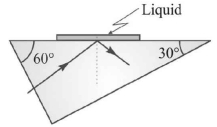
On a hypotenuse of a right angle prism $\left(30^{\circ}-60^{\circ}\right.$ $-90^{\circ}$ ) of refractive index $1.50$, a drop of liquid is placed as shown in figure. Light is allowed to fall normally on the short face of the prism. In order that the ray of light may get totally reflected, the maximum value of refractive index is:
An electric dipole consisting of two opposite charges of $2 \times 10^{-6} \mathrm{C}$ each separated by a distance of 3 cm is placed in an electric field of $2 \times 10^5$ N/C. The maximum torque on the dipole will be
The size of an object as perceived by an eye depends primarily on:
In a moving coil galvanometer, the deflection of the coil θ is related to the electrical current i by the relation
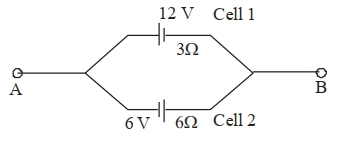
Two cells are connected between points $A$ and $B$ as shown. Cell $1$ has emf of $12\,V$ and internal resistance of $3\,\Omega$. Cell $2$ has emf of $6\,V$ and internal resistance of $6\,\Omega$. An external resistor $R$ of $4\,\Omega$ is connected across $A$ and $B$. The current flowing through $R$ will be $.............A$.
If the difference between $(n+1)^{\text {th }}$ Bohr radius and $n^{\text {th }}$ Bohr radius is equal to the $(n-1)^{\text {th }}$ Bohr radius then find the value of $n$
$^{22}Ne$ nucleus after absorbing energy decays into two $\alpha - $ particles and an unknown nucleus. The unknown nucleus is
Two bulbs are working in parallel order. Bulb A is brighter than bulb B. If $R_A$ and $R_B$ are their resistance respectively then
A wire of $1 \,\Omega$ has a length of $1\, m$. It is stetched till its length increases by $25\, \%$. The percentage change in resistance to the neartest integer is .....$\%$