Question
Two dice are rolled once. Find the probability of getting such numbers on two dice whose product is a perfect square.

Answer

If two dice are rolled together, the possible oucomes are:
(1, 1), (1, 2), (1, 3), (1, 4), (1, 5), (1, 6)
(2, 1), (2, 2), (2, 3), (2, 4), (2, 5), (2, 6)
(3, 1), (3, 2), (3, 3), (3, 4), (3, 5), (3, 6)
(4, 1), (4, 2), (4, 3), (4, 4), (4, 5), (4, 6)
(5, 1), (5, 2), (5, 3), (5, 4), (5, 5), (5, 6)
(6, 1), (6, 2), (6, 3), (6, 4), (6, 5), (6, 6)
So, there are 36 outcomes.
The be a following outcomes will give the product to be a perfect square.
(1, 1), (1, 4), (2, 2), (3, 3), (4, 1), (4, 4), (5, 5), (6, 6)
So, there are 8 possible outcomes.
p(getting number whose product is a perfect square)
$=\frac{8}{36}$
$=\frac{2}{9}$

Need a full question paper?

Generate a complete, print-ready paper with questions like this in minutes — across 16+ boards, with answer keys.
Start Generating Free

Similar questions

A pole $6 m$ high is fixed on the top of a tower. The angle of elevation of the top of the pole observed from a point $P$ on the ground is $60^{\circ}$ and the angle of depression of the point $P$ from the top of the tower is $45^{\circ}$. Find the height of the tower and the distance of point $P$ from the foot of the tower. $($Use $\sqrt{3}=1.73)$
$\triangle ABC \sim \triangle DEF$ and their areas are respectively $100 cm^2$ and $49 cm^2$. If the altitude of $\triangle ABC$ is 5 cm , the corresponding altitude of $\triangle DEF$.
If the equation $\left(1+m^2\right) x^2+2 m c x+\left(c^2-a^2\right)=0$ has equal roots, prove that $c^2=a^2\left(1+m^2\right)$
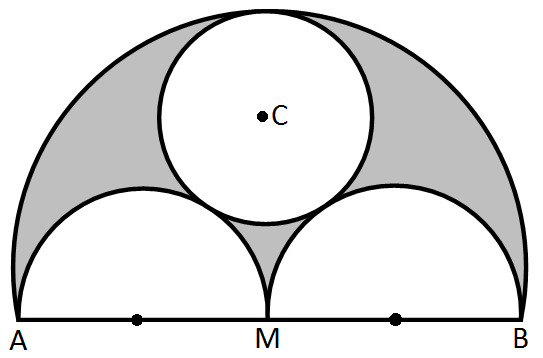
In the following figure, AB = 36cm and M is mid-point of AB. Semi-circles are drawn on AB, AMand MB as diameters. A circle with centre C touches all the three circles. Find the area of the shaded region.
Solve: $\frac{\text{ax}}{\text{b}}-\frac{\text{by}}{\text{a}}=\text{a}+\text{b},$ $\text{ax}-\text{by}=\text{2ab}.$
If G be the centroid of a triangle ABC and P be any other point in the plane, prove that $PA^2 + PB^2 + PC^2 = GA^2 + GB^2 + GC^2 + 3GP^2.$
The adjacent sides of a parallelogram are 32cm and 24cm. If the distance between the longer sides is 17.4cm, find hte distance between the shorter sides.
Find the mode, median and mean for the following data:
Marks Obtained $25-35$ $35-45$ $45-55$ $55-65$ $65-75$ $75-85$
Number of students $7$ $31$ $33$ $17$ $11$ $1$
Solve the following quadratic equations by factorization:
$\frac{16}{\text{x}}-1=\frac{15}{\text{x}+1},$ $\text{x}\neq0,-1$
Prove the following trigonometric identities.
$(\sec\text{A}-\text{cosec A})(1+\tan\text{A}+\cot\text{A})=\tan\text{A}\sec\text{A}-\cot\text{A}\text{ cosec A}$