Question
Two dice are thrown at the same time. Find the probability of getting:
  1. Same number on both dice.
  2. Different numbers on both dice.

Answer

Two dice are thrown at the same time. [given]
So, total number of possible outcomes = 36
  1. We have, same number on both dice.
So, possible outcomes are (1, 1), (2, 2), (3, 3), (4, 4), (5, 5) and (6, 6).

$\therefore$ Number of possible outcomes = 6

Now, required probability $=\frac{6}{36}=\frac{1}{6}$
  1. We have, different number on both dice.
So, number of possible outcomes

= 36 - Number of possible outcomes for same number on both dice

= 36 - 6 = 30

$\therefore\ \text{Required probability}=\frac{30}{36}=\frac{5}{6}$

Need a full question paper?

Generate a complete, print-ready paper with questions like this in minutes — across 16+ boards, with answer keys.

Start Generating Free

Similar questions

Find the mode of the given data:
Class interval
0-20
20-40
40-60
60-80
Frequency
15
6
18
10
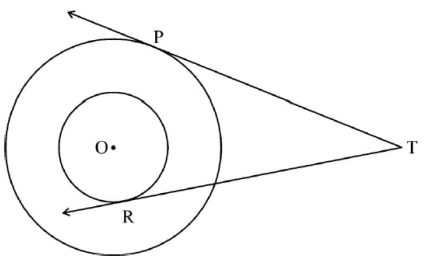
In the given figure, two concentric circles have radii $3 \ cm$ and $5 \ cm$ . Two tangents $TR$ and $TP$ are drawn to the circles from an external point $T$ such that $TR$ touches the inner circle at $R$ and $TP$ touches the outer circle at $P$. If $T R=4 \sqrt{10} \ cm$, then find the length of $T P$.
Image
If a point $A(0, 2)$ is equidistant from the points $B(3, p)$ and $C(p, 5)$, then find the value of $p$.
A bag contains slips numbered from 1 to 100. If Fatima chooses a slip at random from the bag, it will either be an odd number or an even number. Since this situation has only two possible outcomes, so, the probability of each is $\frac{1}{2}.$ Justify.
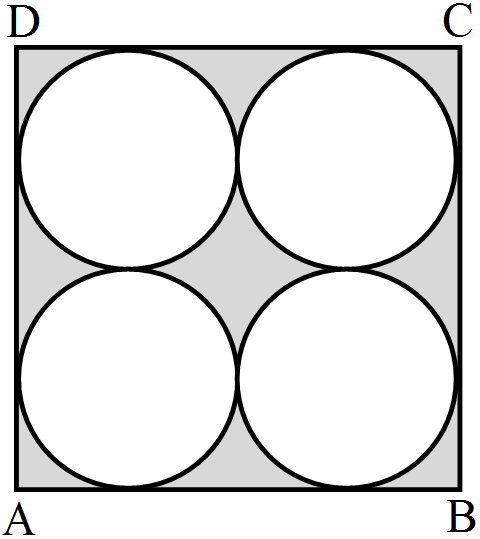
In the given figure, find the area of the shaded region, where ABCD is a square of side 14cm and all circles are of the same diameter.
The $13^{\text {th }}$ term of an AP is 4 times its $3^{\text {rd }}$ term. If its $5^{\text {th }}$ term is 16 , find the sum of its first 10 terms.
The difference of squares of two number is 88. If the larger number is $5$ less than twice the smaller number, then find the two numbers.
How many spherical bullets each of $5\ cm$ in diameter can be cast from a rectangular block of metal $11dm \times 1m \times 5dm$?
Find the mean from the following frequency distribution of marks at a test in statistics:
Marks (x)
5
10
15
20
25
30
35
40
45
50
No. of students (f)
15
50
80
76
72
45
39
9
8
6
Show that the following numbers are irrational.
$7\sqrt{5}$