Question
  1. Two dice, one blue and one grey, are thrown at the same time. Complete the following table:
    Event: Sum on 2 dice 2 3 4 5 6 7 8 9 10 11 12
    Probability $\frac{1}{{36}}$ $\frac{5}{{36}}$ $\frac{1}{{36}}$
  2. A student argues that there are 11 possible outcomes 2, 3, 4, 5, 6, 7, 8, 9, 10, 11 and 12. Therefore, each of them has a probability $\frac{1}{11}$. Do you agree with this argument? Justify your answer.
Answer

  1. It can be observed that,
    To get the sum as 2, possible outcomes = (1, 1)
    To get the sum as 3, possible outcomes = (2, 1) and (1, 2)
    To get the sum as 4, possible outcomes = (3, 1), (1, 3), (2, 2)
    To get the sum as 5, possible outcomes = (4, 1), (1, 4), (2, 3), (3, 2)
    To get the sum as 6, possible outcomes = (5, 1), (1, 5), (2, 4), (4, 2), (3, 3)
    To get the sum as 7, possible outcomes = (6, 1), (1, 6), (2, 5), (5, 2), (3, 4), (4, 3)
    To get the sum as 8, possible outcomes = (6, 2), (2, 6), (3, 5), (5, 3), (4, 4)
    To get the sum as 9, possible outcomes = (3, 6), (6, 3), (4, 5), (5, 4)
    To get the sum as 10, possible outcomes = (4, 6), (6, 4), (5, 5)
    To get the sum as 11, possible outcomes = (5, 6), (6, 5)
    To get the sum as 12, possible outcomes = (6, 6)
    Event 2 3 4 5 6 7 8 9 10 11 12
    Probability $\frac{1}{{36}}$ $\frac{2}{{36}}$ $\frac{3}{{36}}$ $\frac{4}{{36}}$ $\frac{5}{{36}}$ $\frac{6}{{36}}$ $\frac{5}{{36}}$ $\frac{4}{{36}}$ $\frac{3}{{36}}$ $\frac{2}{{36}}$ $\frac{1}{{36}}$
  2. The probability of each of these sums will not be $\frac{1}{11}$ as their sums are not equally likely.

Need a full question paper?

Generate a complete, print-ready paper with questions like this in minutes — across 16+ boards, with answer keys.

Start Generating Free

Similar questions

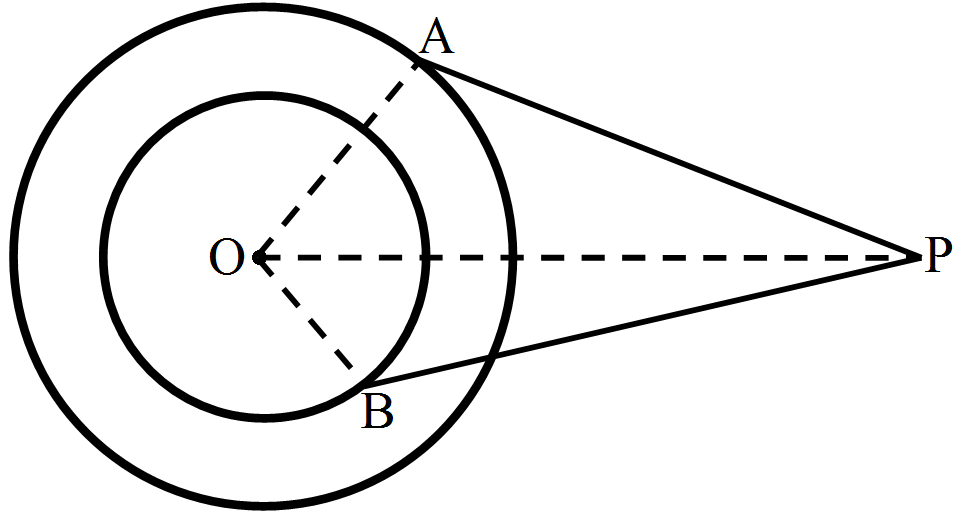
In the given figure, O is the center of two concentric circle of radii 4cm and 6cm respectively. PA and PB are tangle to the outer and inner circle respectively. If PA = 10cm, find the length of PB up to one place of decimal.
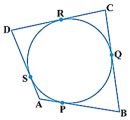
A quadrilateral ABCD is drawn to circumscribe a circle. Prove that AB + CD = AD + BC
Image
The radius of a circle is 17.5cm. Find fhe area of the sector e dosed by two radii and an arc 44cm in length.
Very-Short-Answer Questions:
The LCM of two numbers is 1200. Show that the HCF of these numbers cannot be 500. Why?
Answer the following and justify:
If on division of a non-zero polynomial p(x) by a polynomial g(x), the remainder is zero, what is the relation between the degrees of p(x) and g(x)?
The following are quadratic equations in x?
$\text{x}-\frac{6}{\text{x}}=3$
There are 40 students in a class of whom 25 are girls and 15 are boys. The class teacher has to select one student as a class representative. He writes the name of each student on a separate card, the cards being identical. Then she puts cards in a bag and stirs them thoroughly. She then draws one card from the bag. What is the probability that the name written on the card is the name of:
  1. A girl?
  2. A boy?
State whether the following are true or false. Justify your answer.
cos A is the abbreviation used for the cosecant of angle A.
Find the probability that a number selected from the number 1 to 25 is not a prime number when each of the given numbers is equally likely to be selected.
Find the number of coins, 1.5cm is diameter and 0.2cm thick, to be melted to form a right circular cylinder of height 10cm and diameter 4.5cm.