MCQ
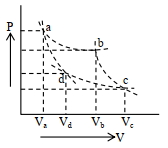
Two different adiabatic paths for the same gas intersect two isothermal curves as shown in$P-V$ diagram. The relation between the ratio $\frac{V_a}{V_d}$ and the ratio $\frac{V_b}{V_c}$ is:
  • A
    $\frac{V_a}{V_d}=\left(\frac{V_b}{V_c}\right)^{-1}$
  • B
    $\frac{V_a}{V_d} \neq \frac{V_b}{V_c}$
  • $\frac{V_a}{V_d}=\frac{V_b}{V_c}$
  • D
    $\frac{V_a}{V_d}=\left(\frac{V_b}{V_c}\right)^2$

Answer

Correct option: C.
$\frac{V_a}{V_d}=\frac{V_b}{V_c}$
c
For adiabatic process

$\mathrm{TV}^{\gamma-1}=\text { constant }$

$\mathrm{T}_{\mathrm{a}} \cdot \mathrm{V}_{\mathrm{a}}^{\gamma-1}=\mathrm{T}_{\mathrm{d}} \cdot \mathrm{V}_{\mathrm{d}}^{\gamma-1}$

$\left(\frac{\mathrm{V}_{\mathrm{a}}}{\mathrm{V}_{\mathrm{d}}}\right)^{\gamma-1}=\frac{\mathrm{T}_{\mathrm{d}}}{\mathrm{T}_{\mathrm{a}}}$

$\mathrm{T}_{\mathrm{b}} \cdot \mathrm{V}_{\mathrm{b}}^{\gamma-1}=\mathrm{T}_{\mathrm{c}} \cdot \mathrm{V}_{\mathrm{c}}^{\gamma-1}$

$\left(\frac{\mathrm{V}_{\mathrm{b}}}{\mathrm{V}_{\mathrm{c}}}\right)^{\gamma-1}=\frac{\mathrm{T}_{\mathrm{c}}}{\mathrm{T}_{\mathrm{b}}}$

$\mathrm{T}_{\mathrm{b}} \cdot \mathrm{V}_{\mathrm{b}}^{\gamma-1}=\mathrm{T}_{\mathrm{c}} \cdot \mathrm{V}_{\mathrm{c}}^{\gamma-1}$

$\left(\frac{\mathrm{V}_{\mathrm{b}}}{\mathrm{V}_{\mathrm{c}}}\right)^{\gamma-1}=\frac{\mathrm{T}_{\mathrm{c}}}{\mathrm{T}_{\mathrm{b}}}$

$\frac{\mathrm{V}_{\mathrm{a}}}{\mathrm{V}_{\mathrm{d}}}=\frac{\mathrm{V}_{\mathrm{b}}}{\mathrm{V}_{\mathrm{c}}} \quad\left(\begin{array}{r}\because \mathrm{T}_{\mathrm{d}}=\mathrm{T}_{\mathrm{c}} \\ \mathrm{T}_{\mathrm{a}}=\mathrm{T}_{\mathrm{b}}\end{array}\right)$
Need a full question paper?

Generate a complete, print-ready paper with questions like this in minutes — across 16+ boards, with answer keys.

Start Generating Free

Similar questions

The temperature of an ideal gas is kept constant as it expands. The gas does external work. During this process, the internal energy of the gas
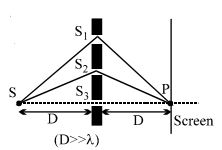
$A$ monochromatic light source of wavelength $\lambda$ is placed at $S$. Three slits $S_1, S_2$ and $S_3$ are equidistant from the source $S$ and the point $P$ on the screen. $S_1P - S_2P = \lambda /6$ and $S_1P - S_3P = 2\lambda /3$. If $I$ be the intensity at $P$ when only one slit is open, the intensity at $P$ when all the three slits are open is
A satellite $S$ is moving in an elliptical orbit around the earth. The mass of the satellite is very small compared to the mass of earth
In case of a forced vibration, the resonance wave becomes very sharp when the
The root mean square velocity of the molecules in a sample of helium is $(5/7)^{th}$ that of the molecules in a sample of hydrogen. If the temperature of hydrogen sample is $0°C,$ then the temperature of the helium sample is about
Light coming from a star is observed to have a wavelength of $3737 Å$, while its real wavelength is $3700 Å$. The speed of the star relative to the earth is [Speed of light $3 \times {10^8}m/s$]
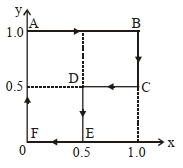
A particle is moved along a path $A B-B C-C D-D E-E F-F A$, as shown in figure, in presence of a force $\overrightarrow{ F }=(\alpha \hat{y}+2 \alpha \hat{x} \hat{j}) N$, where $x$ and $y$ are in meter and $\alpha=-1 N / m ^{-1}$. The work done on the particle by this force $\vec{F}$ will be. . . . . . Joule.
Eight copper wire of length $l$ and diameter $d$ are joined in parallel to form a single composite conductor of resistance $R$. If a single copper wire of length $2\,l$ have the same resistance $(R)$ then its diameter will be $.....d$.
In an experiment to study standing waves, you use a string whose mass per length is $μ$ = $(1.0 ± 0.1) × 10^{-4}\ kg/m$ . You look at the fundamental mode, whose frequency $f$ is related to the length $L$ and tension $T$ of the string by the following equation $L$ = $\frac{1}{{2f}}\sqrt {\frac{T}{\mu }} $ You make a plot with $L$ on the $y-$ axis and $\sqrt T$ on the $x-$ axis, and find that the best fitting line is $y$ = $(8.0 ± 0.3) × 10^{-3}x + (0.2 ± 0.04)$ in $SI\ units$ . What is the value of the frequency of the wave (including the error)? Express your result in $SI\ unit\ (Hz)$
When light wave suffers reflection at the interface from air to glass, the change in phase of the reflected wave is equal to