MCQ
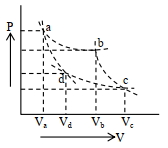
Two different adiabatic paths for the same gas intersect two isothermal curves as shown in$P-V$ diagram. The relation between the ratio $\frac{V_a}{V_d}$ and the ratio $\frac{V_b}{V_c}$ is:
  • A
    $\frac{V_a}{V_d}=\left(\frac{V_b}{V_c}\right)^{-1}$
  • B
    $\frac{V_a}{V_d} \neq \frac{V_b}{V_c}$
  • $\frac{V_a}{V_d}=\frac{V_b}{V_c}$
  • D
    $\frac{V_a}{V_d}=\left(\frac{V_b}{V_c}\right)^2$

Answer

Correct option: C.
$\frac{V_a}{V_d}=\frac{V_b}{V_c}$
c
For adiabatic process

$\mathrm{TV}^{\gamma-1}=\text { constant }$

$\mathrm{T}_{\mathrm{a}} \cdot \mathrm{V}_{\mathrm{a}}^{\gamma-1}=\mathrm{T}_{\mathrm{d}} \cdot \mathrm{V}_{\mathrm{d}}^{\gamma-1}$

$\left(\frac{\mathrm{V}_{\mathrm{a}}}{\mathrm{V}_{\mathrm{d}}}\right)^{\gamma-1}=\frac{\mathrm{T}_{\mathrm{d}}}{\mathrm{T}_{\mathrm{a}}}$

$\mathrm{T}_{\mathrm{b}} \cdot \mathrm{V}_{\mathrm{b}}^{\gamma-1}=\mathrm{T}_{\mathrm{c}} \cdot \mathrm{V}_{\mathrm{c}}^{\gamma-1}$

$\left(\frac{\mathrm{V}_{\mathrm{b}}}{\mathrm{V}_{\mathrm{c}}}\right)^{\gamma-1}=\frac{\mathrm{T}_{\mathrm{c}}}{\mathrm{T}_{\mathrm{b}}}$

$\mathrm{T}_{\mathrm{b}} \cdot \mathrm{V}_{\mathrm{b}}^{\gamma-1}=\mathrm{T}_{\mathrm{c}} \cdot \mathrm{V}_{\mathrm{c}}^{\gamma-1}$

$\left(\frac{\mathrm{V}_{\mathrm{b}}}{\mathrm{V}_{\mathrm{c}}}\right)^{\gamma-1}=\frac{\mathrm{T}_{\mathrm{c}}}{\mathrm{T}_{\mathrm{b}}}$

$\frac{\mathrm{V}_{\mathrm{a}}}{\mathrm{V}_{\mathrm{d}}}=\frac{\mathrm{V}_{\mathrm{b}}}{\mathrm{V}_{\mathrm{c}}} \quad\left(\begin{array}{r}\because \mathrm{T}_{\mathrm{d}}=\mathrm{T}_{\mathrm{c}} \\ \mathrm{T}_{\mathrm{a}}=\mathrm{T}_{\mathrm{b}}\end{array}\right)$
Need a full question paper?

Generate a complete, print-ready paper with questions like this in minutes — across 16+ boards, with answer keys.

Start Generating Free

Similar questions

The acceleration due to gravity on a planet is $1.96 \,m / s ^2$. If it is safe to jump from a height of $3 \,m$ on the earth, the corresponding height on the planet will be ........ $m$
Beats are produced by two waves given by $y_1 = a\,\, sin\,\,2000\,\, \pi t$ and $y_2 = a\,\, sin\,\, 2008\,\, \pi t$ . The number of beats heard per second is
A particle is tied to $20\,cm$ long string. It performs circular motion in vertical plane. What is the angular velocity of string when the tension in the string at the top is zero .......... $rad/sec$
An electric motor exerts a force of $40\, N$ on a cable and pulls it by a distance of $30\, m$ in one minute. The power supplied by the motor is .............. $\mathrm{W}$
A piece of marble is projected from earth's surface with velocity of $19.6 \sqrt{2}\,m / s$ at $45^{\circ}.$ $2\,s$ later its velocity makes an angle $\alpha$ with horizontal, where $\alpha$ is $..........$
A stick of mass $m$ and length $l$ is pivoted at one end and is displaced through an angle $\theta$. The increase in potential energy is ............
Figure shows the variation of the moment of inertia of a uniform rod, about an axis passing through its centre and inclined at an angle $\theta$ to the length. The moment of inertia of the rod about an axis passing through one of its ends and making an angle $\theta  = \frac{\pi }{3}$ will be ........ $ kg-m^2$.
The energy density in the electric field created by a point charge falls off with the distance from the point charge as:

  1. $\frac{1}{\text{r}}$

  2. $\frac{1}{\text{r}^2}$

  3. $\frac{1}{\text{r}^3}$

  4. $\frac{1}{\text{r}^4}$

A man of mass $m$ starts falling towards a planet of mass $M$ and radius $R$. As he reaches near to the surface, he realizes that he will pass through a small hole in the planet. As he enters the hole, he sees that the planet is really made of two pieces a spherical shell of negligible thickness of mass $2 M / 3$ and a point mass $M / 3$ at the centre. Change in the force of gravity experienced by the man is
A disc of radius $5\, m$ is rotating with angular frequency $10\, rad / sec .$ A block of mass $2\, kg$ to be put on the disc friction coefficient between disc and block is $\mu_{ k }=0.4,$ then find the maximum distance from axis where the block can be placed without sliding (in $cm$)