Question
Two different dice are thrown together. Find the probability that the numbers obtained:
  1. Have a sum less than 7.
  2. Have a product less than 16.
  3. Is a doublet of odd numbers.

Answer

The outcomes when two dice are thrown together are:
(1, 1), (1, 2), (2, 3), (1, 4), (1, 5), (1, 6)
(2, 1), (2, 2), (2, 3), (2, 4), (2, 5), (2, 6)
(3, 1), (3, 2), (3, 3), (3, 4), (3, 5), (3, 6)
(4, 1), (4, 2), (4, 3), (4, 4), (4, 5), (4, 6)
(5, 1), (5, 2), (5, 3), (5, 4), (5, 5), (5, 6)
(6, 1), (6, 2), (6, 3), (6, 4), (6, 5), (6, 6)
  1. Let A be the event of getting the number whose sum is less than 7.
The outcomes in favour of event A are: (1, 1), (1, 2), (1, 3), (1, 4), (1, 5), (2, 1), (2, 2), (2, 3), (2, 4), (3, 1), (3, 2), (3, 3), (4, 1), (4, 2) and (5, 1)

Number of favourable outcones = 15

$\therefore\ \text{P(A)}=\frac{\text{Number of favourable outcomes}}{\text{Total number of outcomes}}$

$=\frac{15}{36}$

$=\frac{5}{12}$
  1. Let B be the event of getting the number whose product is less than 16.
The outcomes in favour of event B are: (1, 1), (1, 2), (1, 3), (1, 4), (1, 5), (1, 6), (2, 1), (2, 2), (2, 3), (2, 4), (2, 5), (2, 6), (3, 1), (3, 2), (3, 3), (3, 4), (3, 5), (4, 1), (4, 2), (4, 3), (5, 1), (5, 2), (5, 3), (6, 1) and (6, 2).
  1. Let C be the event of getting the number which are doublets of odd numbers
The outcomes in favour of event C are (1, 1), (3, 3) and (5, 5)

Number of favourable outcomes = 3

$\therefore\ \text{P(A)}=\frac{\text{Number of favourable outcomes}}{\text{Total number of outcomes}}$

$=\frac{3}{36}$

$=\frac{1}{12}$
Need a full question paper?

Generate a complete, print-ready paper with questions like this in minutes — across 16+ boards, with answer keys.

Start Generating Free

Similar questions

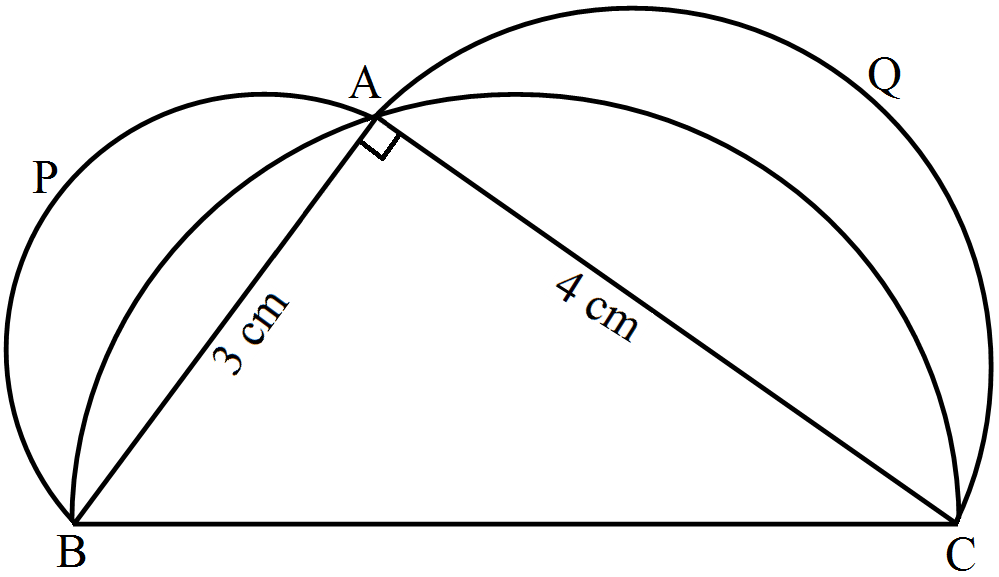
In the given fingure, $\triangle\text{ABC}$ is right-angled at A. semicircles are drawn on AB, AC and BC as diameter, it is given that AB = 3cm and AC = 4cm. find the area of the shaded region.
If a line is drawn parallel to one side of a triangle to intersect the other two sides in distinct points, then prove that the other two sides are divided in the same ratio.
Prove the following trigonometric identities.
$\frac{\tan^3\theta}{1+\tan^2\theta}+\frac{\cot^3\theta}{1+\cot^2\theta}=\sec\theta\text{cosec}\theta-2\sin\theta\cos\theta$
If $\angle\text{A}$ and $\angle\text{B}$ are acute angles such that $\sin\text{A}=\sin\text{B}$ then prove that $\angle\text{A}=\angle\text{B}.$
The midpoint of the line segment joining A(2a, 4) and B(-2, 3b) is C(1, 2a + 1). Find the values of a and b.
Solve the following system of equations by the method of cross-multiplication:$\frac{57}{\text{x}+\text{y}}+\frac{6}{\text{x}-\text{y}}=5,$
$\frac{38}{\text{x}+\text{y}}+\frac{21}{\text{x}-\text{y}}=9.$
For the following statments state whether true (T) or false(F):
If two triangles are similar then their corresponding angles are equal and their corresponding sides are equal.
The following table shows the ages of the patients admitted in a hospital during a year:
Age (in years) 5-15 15-25 25-35 35-45 45-55 55-65
Number of patients 6 11 21 23 14 5
Find the mode and the mean of the data given above. Compare and interpret the two measures of central tendency.
The incomes of X and Y are in the ratio of 8 : 7 and their expenditures are in the ratio 19 : 16. If each saves Rs. 1250, find their incomes.
The sum of the $4^{\text {th }}$ and the $8^{\text {th }}$ term of an AP is 24 and the sum of its $6^{\text {th }}$ and $10^{\text {th }}$ terms is 44 . Find the sum of its first 10 terms.