Question

Two ends of a conductor are at different temperatures the electromotive force generated between two ends is

(a) Seebeck electro motive force (e.m.f.)

(b) Peltier electro motive force (e.m.f.)

(c) Thomson electro motive force (e.m.f.)

(d) None of these

Answer

(c) Thomson electro motive force (e.m.f.)

Need a full question paper?

Generate a complete, print-ready paper with questions like this in minutes — across 16+ boards, with answer keys.

Start Generating Free

Similar questions

A charge + q is sent through a magnetic field. The force acting on it is maximum when the angle between the direction of motion of the charged particle and the magnetic field:
The energy density of magnetic field $\vec{B}$ is :
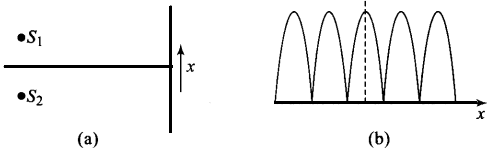
Two source S1 and S2 of intensity I1 and I2 are placed in front of a screen [Fig. (a)]. The patteren of intensity distribution seen in the central portion is given by Fig. (b).

In this case which of the following statements are true.

A nucleus of   originally at rest emits a particle with speed v. What will be the recoil speed of the daughter nucleus

(a) 4v/206

(b) 4v/214

(c) v/206

(d) v/214

A circular metal plate of radius R is rotating with a uniform   angular velocity ω with its plane perpendicular to a uniform magnetic field B. Then the emf developed between the centre and the rim of the plate is

(a) πω 

(b) ω

(c) πω

(d) ω 

Carbon, silicon and germanium have four valence electrons each. These are characterised by valence and conduction bands separated by energy band gap respectively equal to $\left(E_g\right)_C,\left(E_g\right)_{S i}$ and $\left(E_g\right)_{G e}$. Which of the following statements is true?

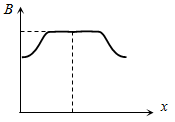
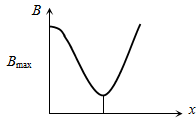
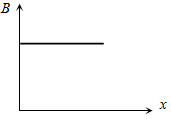
The correct curve between the magnetic induction (B) along the axis of a long solenoid due to current flow i in it and distance x from one end is

(a)

(b)

(c)

(d)

A circular coil expands radially in a region of magnetic field and no electromotive force is produced in the coil. This can be because
In which of the following, emission of electrons does not take place?

An electric dipole of moment p is placed at the origin along the x-axis. The electric field at a point P, whose position vector makes an angle θ with the x -axis, will make an angle ..... with the x -axis, where  tanα =  

(a) α

(b) θ

(c) θ + α

(d) θ  +2 α