MCQ
Two engines pass each other moving in opposite directions with uniform speed of $30\,m/s$ . One of them is blowing a whistle of frequency $540\,Hz.$ Calculate the frequency heard by driver of second engine before they pass each other  ... $Hz$. Speed of sound is $330\,m/sec$
  • A
    $450$
  • B
    $540$
  • C
    $270$
  • $648$

Answer

Correct option: D.
$648$
d
We know that the apperent frequency

$\mathrm{f}^{\prime}=\left(\frac{\mathrm{v}-\mathrm{v}_{0}}{\mathrm{v}-\mathrm{v}_{\mathrm{s}}}\right) \mathrm{f}$ from Doppler's effect

where $v_{0}=v_{s}=30 \mathrm{m} / \mathrm{s},$ velocity of observer and source

Speed of sound $v=330 \mathrm{m} / \mathrm{s}$

$\because$ Frequency of whistle $(\mathrm{f})=540 \mathrm{Hz}$

$\therefore \mathrm{f}^{\prime}=\frac{330+30}{330-30} \times 540=648 \mathrm{Hz}$

Need a full question paper?

Generate a complete, print-ready paper with questions like this in minutes — across 16+ boards, with answer keys.

Start Generating Free

Similar questions

Two moles of helium are mixed with $n$  with moles of hydrogen. If $\frac{{{C_P}}}{{{C_V}}}\, = \,\frac{3}{2}$  for the mixture, then the value of $n$  is
Starting with the same initial conditions, an ideal gas expands from volume $V_{1}$ to $V_{2}$ in three different ways. The work done by the gas is $W_{1}$ if the process is purely isothermal. $W _{2}$. if the process is purely adiabatic and $W _{3}$ if the process is purely isobaric. Then, choose the coned option
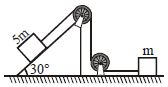
Acceleration of system is :-
The centre of mass of a system of two particles divides the distance between them:
Which of the following graphs correctly represents the relation between ln $E$ and ln $T$ where $E$ is the amount of radiation emitted per unit time from unit area of a body and $T$ is the absolute temperature
Let $V$ and $E$ be the gravitational potential and gravitational field at a distance $r$ from the centre of a uniform spherical shell. Consider the following two statements:
$A.$ The plot of $V$ against $r$ is discontinuous.
$B.$ The plot of $E$ against $r$ is discontinuous.
The nature of damped oscillation is:
An incompressible fluid flows steadily through a cylindrical pipe which has radius $2r$ at point $A $ and radius $r $ at $B $ further along the flow direction. If the velocity at point $A$  is $v, $ its velocity at point $B$  is
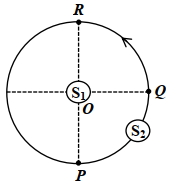
$S_1$ and $S_2$ are two identical sound sources of frequency $656 Hz$. The source $S_1$ is located at $O$ and $S_2$ moves anti-clockwise with a uniform speed $4 \sqrt{2} ms ^{-1}$ on a circular path around $O$, as shown in the figure. There are three points $P, Q$ and $R$ on this path such that $P$ and $R$ are diametrically opposite while $Q$ is equidistant from them. A sound detector is placed at point $P$. The source $S_1$ can move along direction $O P$.

[Given: The speed of sound in air is $324 ms ^{-1}$ ]

($1$) When only $S_2$ is emitting sound and it is $Q$, the frequency of sound measured by the detector in $Hz$ is. . . . . .

($2$) Consider both sources emitting sound. When $S_2$ is at $R$ and $S_1$ approaches the detector with a speed $4 ms ^{-1}$, the beat frequency measured by the detector is $\qquad$ $Hz$.

A student measured the length of a rod and wrote it as $3.50\;cm$. Which instrument did he use to measure it?