Question
Two equal chords $AB$ and $CD$ of a circle when produced intersect at a point $P.$ Prove that $PB = PD$

Answer

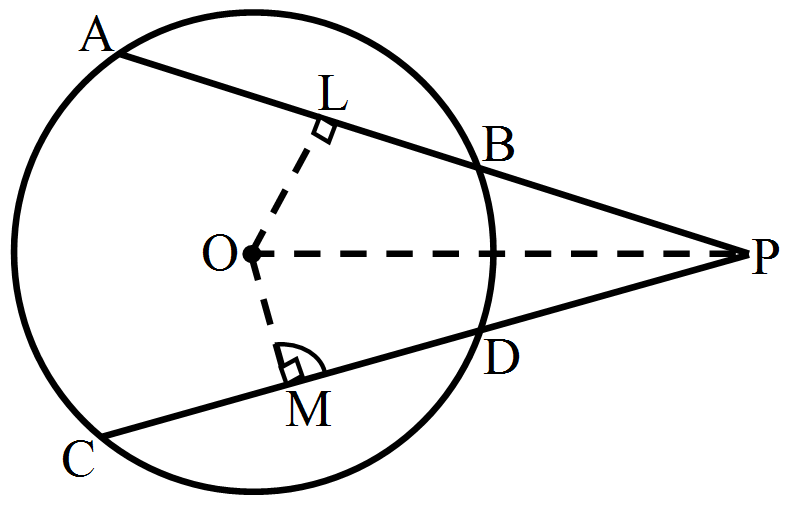
Given: Two equal chords $AB$ and $CD$ of a circle intersecting at a point $P.$

To prove: $PB = PD$​​​​​​​
Construction: Join $OP,$ draw $\text{OL}\bot\text{AB}$ and $\text{OM}\bot\text{CD}$
Proof: We have, $AB = CD$
$\Rightarrow\text{OL}=\text{OM} [$equal chords are equidistant from the centre$]$ In
$\triangle\text{OLP}$ and $\triangle\text{OMP}\ \ \text{OL}=\text{OM}$ [proved above]
$\angle\text{OLP}=\angle\text{OMP}[ $each $90^\circ ]$ and $OP = OP [$common side$]$
$\therefore\triangle\text{OLP}=\triangle\text{OMP} [$by $RHS$ congruence rule$]$
$\Rightarrow\text{LP}=\text{MP} [$by $CPCT] ...(i)$
Now, $AB = CD$
$\Rightarrow\frac{1}{2}(\text{AB})=\frac{1}{2}(\text{CD}) [$dividing both sides by $2]$
$\Rightarrow\text{BL}=\text{DM}\ \ ...(\text{ii}) [$perpendicular drawn from centre to the circle bisects the chord i.e., $AL = LB$ and $CM = MD]$
On subtracting Eq. $(ii)$ from Eq. $(ii)$
we get $LP - BL = MP - DM $
$​​​​​​​\Rightarrow PB = PD$ Hence proved.

Need a full question paper?

Generate a complete, print-ready paper with questions like this in minutes — across 16+ boards, with answer keys.
Start Generating Free

Similar questions

The perimeter of a triangle is $50\ cm$. One side of the triangle is $4\ cm$ longer than the smallest side and the third side is $6\ cm$ less than twice the smallest side. Find the area of the triangle.
$ABC$ is a right triangle such that $AB = AC$ and bisector of angle $C$ intersects the side $AB$ at $D.$ Prove that $AC + AD = BC.$
Prove that: $\frac{1}{1+\sqrt{2}}+\frac{1}{\sqrt{2}+\sqrt{3}}+\frac{1}{\sqrt{3}+\sqrt{4}}+\frac{1}{\sqrt{4}+\sqrt{5}}\\+\frac{1}{\sqrt{5}+\sqrt{6}}+\frac{1}{\sqrt{6}+\sqrt{7}}+\frac{1}{\sqrt{7}+\sqrt{8}}+\frac{1}{\sqrt{8}+\sqrt{9}}=2$
The lengths of the sides of a triangle are in a ratio of $3 : 4 : 5$ and its perimeter is $144\ cm$. Find the area of the triangle and the height corresponding to the longest side.
Water flows at the rate of $10$ metres per minute through a cylindrical pipe $5\ mm$ in diameter. How long would it take to fill a conical vessel whose diameter art the surface $40\ cm$ and depth $24\ cm$?
Three coins are tossed $200$ times and we get: Three heads: $39$ times; two heads: $58$ times; One head: $67$ times; $0$ head: $36$ times. When three coins are tossed at random, what is the probability of getting
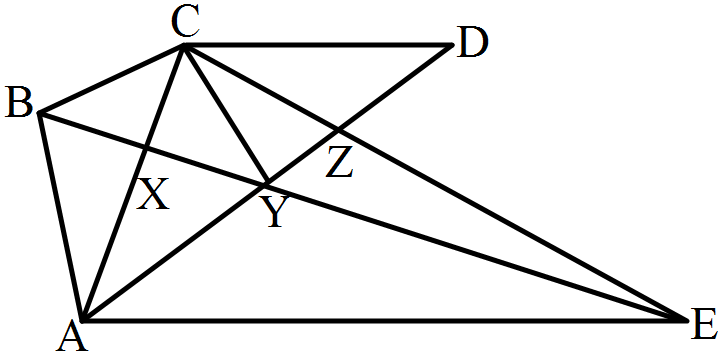
In the given figure, $CD \| AE$ and $CY \| BA$.
$i.$ Name a triangle equal in area of $\triangle\text{CBX}$
$ii.$ Prove that $\text{ar}(\triangle\text{ZDE})=\text{ar}(\triangle\text{CZA})$
$iii.$ Prove that $\text{ar}(\text{BCZY})=\text{ar}(\triangle\text{EDZ}).$
A well with $14\ m$ diameter is dug $8\ m$ deep. The earth taken out of it has been evenly spread all around it to a width of $21\ m$ to form an embankment. Find the height of the embankment.
$D$ is any point on the side $AC$ of $\triangle\text{ABC}$ with $AB = AC$. Show that $CD < BD$.
Multiply $x^2 + 4y^2 + z^2 + 2xy + xz - 2yz by(-z + x - 2y).$