Question
Two equal chords AB and CD of a circle when produced intersect at a point P. Prove that PB = PD
Answer

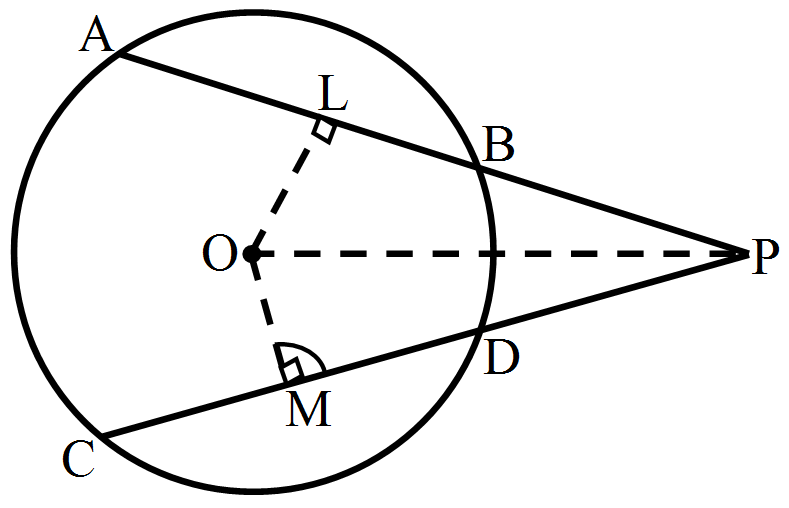
Given: Two equal chords AB and CD of a circle intersecting at a point P.

To prove: PB = PD
Construction: Join OP, draw $\text{OL}\bot\text{AB}$ and $\text{OM}\bot\text{CD}$
Proof: We have, AB = CD
$\Rightarrow\text{OL}=\text{OM}$ [equal chords are equidistant from the centre]
In $\triangle\text{OLP}$ and $\triangle\text{OMP}\ \ \text{OL}=\text{OM}$ [proved above]
$\angle\text{OLP}=\angle\text{OMP}$ [each 90°]
and OP = OP [common side]
$\therefore\triangle\text{OLP}=\triangle\text{OMP}$ [by RHS congruence rule]
$\Rightarrow\text{LP}=\text{MP}$ [by CPCT] ...(i)
Now, AB = CD
$\Rightarrow\frac{1}{2}(\text{AB})=\frac{1}{2}(\text{CD})$ [dividing both sides by 2]
$\Rightarrow\text{BL}=\text{DM}\ \ ...(\text{ii})$
[perpendicular drawn from centre to the circle bisects the chord i.e., AL = LB and CM = MD]
On subtracting Eq. (ii) from Eq. (ii) we get
LP - BL = MP - DM ⇒ PB = PD
Hence proved.

Need a full question paper?

Generate a complete, print-ready paper with questions like this in minutes — across 16+ boards, with answer keys.
Start Generating Free

Similar questions

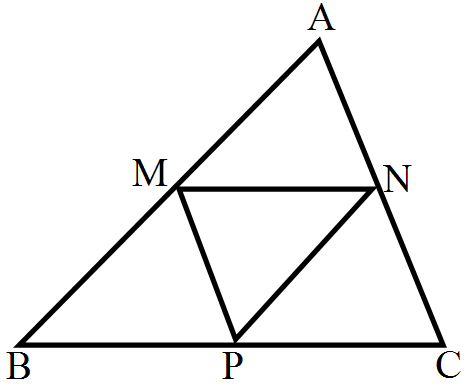
In figure, M, N and P are mid-points of AB, AC and BC respectively. If MN = 3cm, NP = 3.5cm and MP = 2.5cm, calculate BC, AB and AC.

A hollow sphere of internal and external radii 2cm and 4cm respectively is melted into a cone of base radius 4cm. Find the height and slant height of the cone.
Draw the graph of the following linear equations in two variables:
2y = -x + 1
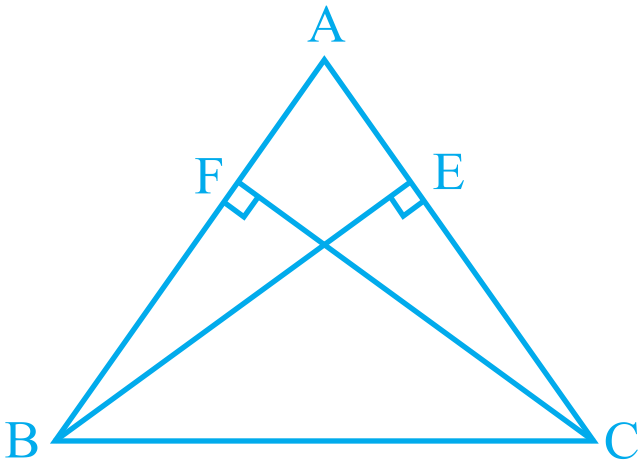
ABC is an isosceles triangle in which altitudes BE and CF are drawn to equal sides AC and AB respectively. Show that these altitudes are equal.

Following are the ages of 360 patients getting medical treatment in a hospital on a day.
Age (in years)
10-20
20-30
30-40
40-50
50-60
60-70
No of Patients
90
50
60
80
50
30
Construct a cumulative frequency table.
Find the length of cloth used in making a conical pandal of height 100m and base radius 240m, if the cloth is $100\pi\text{m}$ wide.
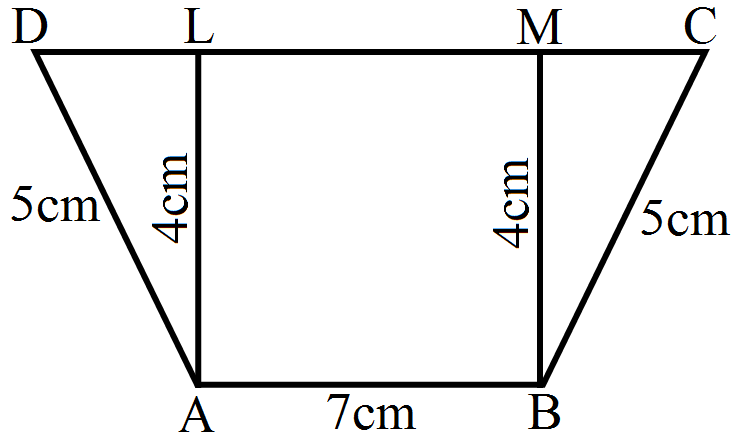
In the adjoining figure, ABCD is a trapezium in which AB || DC; AB = 7cm; AD = BC = 5cm and the distance between AB and DC is 4cm. Find the length of DC and hence, find the area of trap. ABCD.

ABCD is a cyclic qudrilateral in which:
$\text{BC}\parallel\text{AD},\ \angle\text{ADC}=110^\circ$ and $\angle\text{BAC}=50^\circ.$ Find $\angle\text{DAC}.$
In a $\triangle\text{ABC},$ E and F are the mid-points of AC and AB respectively. The altitude AP to BC intersects FE at Q. Prove that AQ = QP.
On a common hypotenuse AB, two right triangles ACB and ADB are situated on opposite sides. Prove that $\angle\text{BAC} = \angle\text{BDC.}$