MCQ
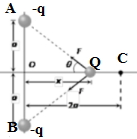
Two equal negative charges are fixed at the points $ [0, a ]$ and $[0, -a]$ on the $y-$ axis. A positive charge $Q$ is released from rest at the points $[2a, 0]$ on the $x-$axis . The charge $Q$ will
  • A
    execute simple harmonic motion about the origin
  • B
    move to the origin and remain at rest
  • C
    move to infinity
  • execute oscillatory but not simple harmonic motion.
Answer

Correct option: D.
execute oscillatory but not simple harmonic motion.
d
The net force is given as,

$F_{n}=2 F \cos \theta$

$=2 \times \frac{1}{4 \pi \varepsilon_{0}}\left(\frac{-q Q}{a^{2}+x^{2}}\right) \times\left(\frac{x}{\left(a^{2}+x^{2}\right)^{\frac{1}{2}}}\right)$

Thus, the restoring force is not linear, So, the motion will not be simple harmonic motion but the motion will be oscillatory.

Need a full question paper?

Generate a complete, print-ready paper with questions like this in minutes — across 16+ boards, with answer keys.

Start Generating Free

Similar questions

The eye can detect  $5 ×10^4$ photons per square metre per sec of green light ($\lambda$ $= 5000\ \mathop A\limits^o $) while the ear can detect ${10^{ - 13}}\,(W/{m^2})$. The factor by which the eye is more sensitive as a power detector than the ear is close to
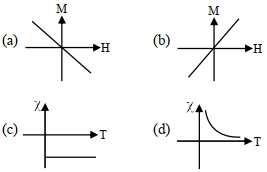
Following plots show Magnetization $(M)$ $vs$ Magnetising field $(H)$ and Magnetic susceptibility $(\chi)$ vs temperature $(T)$ graph :

Which of the following combination will be represented by a diamagnetic material?

A sound is produced by plucking a string in a musical instrument, then
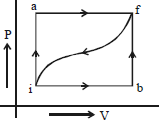
When a system is taken from a state $i$ to $f$ along the path $iaf$ (as shown in the figure). $Q = 50\, cal$ and $W = 20\, cal$ ; along path $ibf,$ $Q = 36\, cal.$

$(i)$ What is $W$ along path $ibf$ ?

$(ii)$ If $W = 13$ cal for path $fi$, what is $Q$ for the path $fi$ ?

$(iii)$ Take $E_{int,i} = 10\,\, cal$ then what is $E_{int,f}$ ?

In an atomic bomb, the energy is released due to
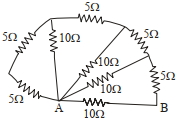
The equivalent resistance between points $A$ and $B$ in the given network is ............ $\Omega$
The reciprocal of resistance is
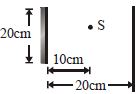
A point source of light $S$ is placed at a distance $10\,cm$ infront of the centre of a mirror of width $20\,cm$ suspended vertically on a wall. A man walks with a speed $10\,cm/s$ infront of the mirror along a line parallel to the mirror at a distance $20\,cm$ from it as shown in figure. Find the maximum time during which he can see the image of the source $S$ in the mirror......$s$
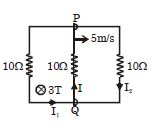
A rectangular loop has a sliding connector $PQ$ of length $2\ m$ and resistance $10\Omega $ and it is moving with a speed $5\ m/s$ as shown. The set-up is placed in a uniform magnetic field $3T$ going into the plane of the paper. The three currents $I_1$ , $I_2$ and $I$ are 
$A$ light of wavelength $6300Å$ shine on a two narrow slits separated by a distance $1.0\, mm$ and illuminates a screen at $a$ distance $1.5\, m$ away. When one slit is covered by a thin glass of refractive index $1.8$ and other slit by a thin glass plate of refractive index $\mu$ , the central maxima shifts by $6^o$. Both plates have same thickness of $0.5\, mm$. The value of refractive index $\mu$ of the plate is