Question
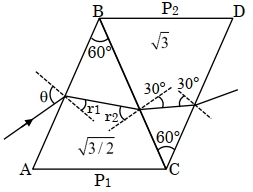
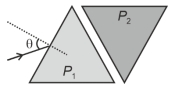
Two equilateral-triangular prisms $P_1$ and $P_2$ are kept with their sides parallel to each other, in vacuum, as shown in the figure. A light ray enters prism $P_1$ at an angle of incidence $\theta$ such that the outgoing ray undergoes minimum deviation in prism $P_2$. If the respective refractive indices of $P_1$ and $P_2$ are $\sqrt{\frac{3}{2}}$ and $\sqrt{3}, \theta=\sin ^{-1}\left[\sqrt{\frac{3}{2}} \sin \left(\frac{\pi}{\beta}\right)\right]$, where the value of $\beta$ is. . . . 
Answer

At surface $BC$

$\sqrt{\frac{3}{2}} \sin r _2=\sqrt{3} \sin 30$

$\sqrt{\frac{3}{2}} \sin r _2=\frac{\sqrt{3}}{2}$

$\operatorname{sinr_{2}}=\frac{1}{\sqrt{2}}$

$I _2=45^{\circ}$

$r _1=60^{\circ}-45^{\circ}=15^{\circ}$

At surface $A B$

$1 \sin \theta=\sqrt{\frac{3}{2}} \sin 15^{\circ}$

$\theta=\sin ^{-1}\left[\sqrt{\frac{3}{2}} \sin \frac{\pi}{12}\right]$

$\beta=12$

Need a full question paper?

Generate a complete, print-ready paper with questions like this in minutes — across 16+ boards, with answer keys.

Start Generating Free