MCQ
Two events take place simultaneously at points $A$ and $B$ as seen in the lab frame. They also occur simultaneously in a frame moving with respect to the lab in a direction:
  • A
    Parallel to $AB$.
  • Perpendicular to $AB$.
  • C
    Making an angle of $45^\circ$ with $AB$.
  • D
    making an angle of $135^\circ$ with $AB.$
Answer

Correct option: B.
Perpendicular to $AB$.
Two events take place simultaneously at points $A$ and $B$ as seen in the Jab frame.
They also occur simultaneously in a frame moving with respect to the lab in a direction will be Perpendicular to $AB$.

Need a full question paper?

Generate a complete, print-ready paper with questions like this in minutes — across 16+ boards, with answer keys.

Start Generating Free

Similar questions

Will a current loop placed in a magnetic field always experience a zero force?
If the intensity of radiation in a photocell is increased how does the stopping potential vary?
Name the physical quantity whose unit is Joule/Coulomb. Is it a vector quantity or a scalar?
A vertical metal cylinder of radius 2cm and length 2m is fixed at the lower end and a load of 100kg is put on it. Find
  1. The stress.
  2. The strain and.
  3. The compression of the cylinder. Young's modulus of the metal $= 2 × 10^{11}\ N/m^2$.
Which part of electromagnetic spectrum form sun is absorbed by the ozone layer?
If the self-inductance of an iron core inductor increases from 0·01mH to 10mH on introducing the iron core into it, what is the relative permeability of the core material used?
An experimenter measures the length of a rod. Initially the experimenter and the rod are at rest with respect to the lab. Consider the following statements:
  1. If the rod starts moving parallel to its length but the observer stays at rest, the measured length will be reduced.
  2. If the rod stays at rest but the observer starts moving parallel to the measured length of the rod, the length will be reduced.
The intensity produced by a long cylindrical light source at a small distance r from the source is proportional to:
  1. $\frac{1}{\text{r}^2}$
  2. $\frac{1}{\text{r}^3}$
  3. $\frac{1}{\text{r}}$
  4. None of these.
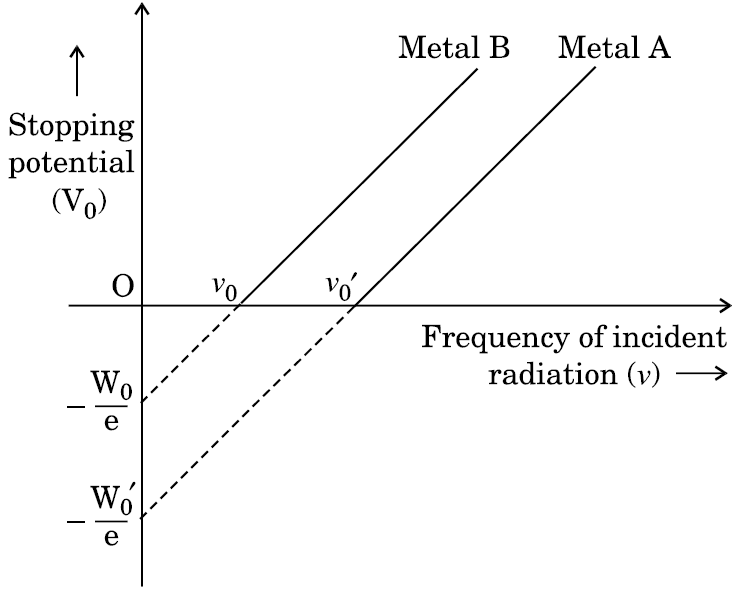
The graph shows variation of stopping potential $V_0$ versus frequency of incident radiation v for two photosensitive metals A and B. Which of the two metals has higher threshold frequency and why?
Name any two semiconductor alloys.