Question
Two free parallel wires carrying currents in opposite direction
| (a) Attract each other |
| (b) Repel each other |
| (c) Neither attract nor repel |
| (d) Get rotated to be perpendicular to each other |
Two free parallel wires carrying currents in opposite direction
| (a) Attract each other |
| (b) Repel each other |
| (c) Neither attract nor repel |
| (d) Get rotated to be perpendicular to each other |
(b) Repel each other
Generate a complete, print-ready paper with questions like this in minutes — across 16+ boards, with answer keys.
The process of adding impurities to the pure semiconductor is called
|
(a) Drouping |
(b) Drooping |
(c) Doping |
(d) None of these |
In a triclinic crystal system
|
(a) a ≠ b ≠ c, α ≠ β ≠ γ |
(b) a = b = c, α ≠ β ≠ γ |
|
(c) a ≠ b ≠ c, α ≠ β = γ |
(d) a = b ≠ c, α = β = γ |
Consider two points 1 and 2 in a region outside a charged sphere. Two points are not very far away from the sphere. If E and V represent the electric field vector and the electric potential, which of the following is not possible
|
(a) | |
(b) | |
|
(c) | |
(d) | |
On the bombardment of neutron with Boron. a-particle is emitted and product nuclei formed is
|
(a) |
(b) |
(c) |
(d) |
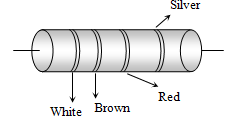
In the figure a carbon resistor has bands of different colours on its body as mentioned in the figure. The value of the resistance is
|
(a) 2.2 k W |
(b) 3.3 k W |
(c) 5.6 k W |
(d) 9.1 k W |