Question
Two free parallel wires carrying currents in opposite direction(a) Attract each other(b) Repel each other(c) Neither attract nor repel(d) Get rotated to be perpendicular to each other


Answer

(b) Repel each other

Need a full question paper?

Generate a complete, print-ready paper with questions like this in minutes — across 16+ boards, with answer keys.
Start Generating Free

Similar questions

An electron and a proton are both released from rest 1 meter from a large stationary negative charge, considering only the force from the large stationary negative charge on the proton and electron. Which of the following is true?
The wavelength of light visible to eye is of the order of:
Which of the following quantities increase when wavelength is increased? Consider only the magnitudes.
  1. The power of a converging lens.
  2. The focal length of a converging lens.
  3. The power of a diverging lens.
  4. The focal length of a diverging lens.
How does the potential difference change with the effect of the dielectric when the battery remains connected across the capacitor?
If a piece of metal was thought to be magnet, which one of the following observations would offer conclusive evidence(a) It attracts a known magnet(b) It repels a known magnet(c) Neither (a) nor (b)(d) It attracts a steel screw driver
   
   
The activity of a radioactive sample(a) Can be increased by heating it(b) Is independent of physical parameter(c) Cannot be increased by any method(d) Both (b) and (c)
   
   
When the charged particles move in a combined magnetic and electric field, then the force acting is known as _________.
Light of wavelength l = 5000 Å falls normally on a narrow slit. A screen placed at a distance of 1 m from the slit and perpendicular to the direction of light. The first minima of the diffraction pattern is situated at 5 mm from the centre of central maximum. The width of the slit is (a) 0.1 mm(b) 1.0 mm(c) 0.5 mm(d) 0.2 mm
       
The correct symbol for zener diode is
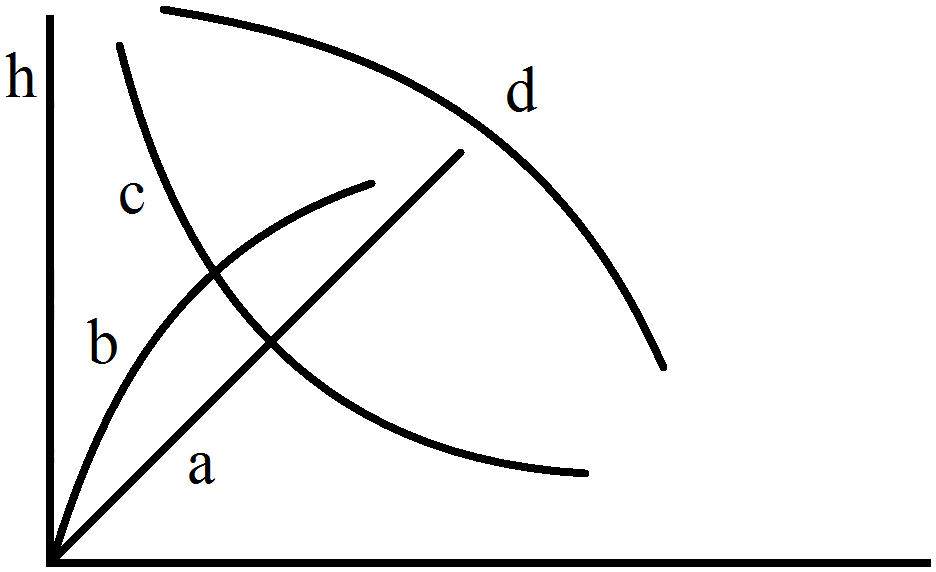
Which of the following graphs may represent the relation between the capillary rise h and the radius r of the capillary?