MCQ
Two free parallel wires carrying currents in the opposite directions:
- AAttract each other.
- BRepel each other.
- CDo not attract each other.
- DGet rotated to be perpendicular to each other.
Generate a complete, print-ready paper with questions like this in minutes — across 16+ boards, with answer keys.
In order to forward bias a PN junction, the negative terminal of battery is connected to
|
(a) P–side |
(b) Either P–side or N–side |
|
(c) N–side |
(d) None of these |
A milliammeter of range 10 mA has a coil of resistance 1 W. To use it as voltmeter of range 10 volt, the resistance that must be connected in series with it, will be
|
(a) 999 W |
(b) 99 W |
(c) 1000 W |
(d) None of these |
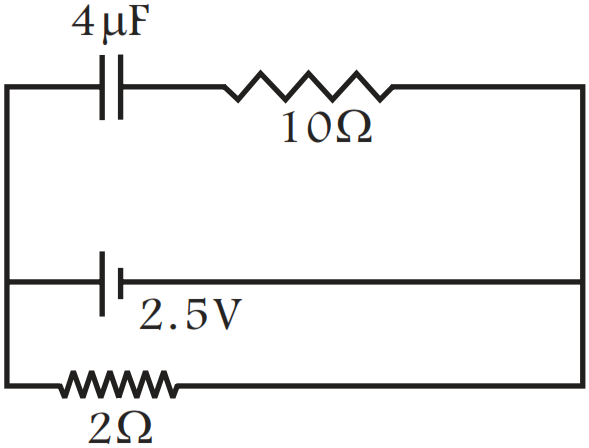
Two parallel plates separated by a distance of 5mm are kept at a potential difference of 50 V. A particle of mass  and charge
  enters in it with a velocity
  . The acceleration of the particle will be
|
(a) |
(b) |
(c) |
(d) 2 |
A coil is wound as a transformer of rectangular cross-section. If all the linear dimensions of the transformer are increased by a factor 2 and the number of turns per unit length of the coil remain the same, the self inductance increased by a factor of
|
(a) 16 |
(b) 12 |
(c) 8 |
(d) 4 |
Then


