Question
Two $H$ atoms in the ground state collide inelastically. The maximum amount by which their combined kinetic energy is reduced is :

Answer

$10.20eV.$
Key concept :
Total energy $(E)$ is the sum of potential energy and kinetic energy, i.e. $E = K + U$
$\Rightarrow\ \text{E}=-\frac{\text{kZe}^2}{2\text{r}_\text{n}}$ also ${r}_\text{n}=\frac{\text{n}^2\text{h}^2\epsilon_0}{\pi\text{mze}^2}$
Hence $\text{E}=-\bigg(\frac{\text{me}^4}{8\epsilon_0^2\text{h}^2}\bigg)\frac{\text{Z}^2}{\text{n}^2}=-\bigg(\frac{\text{me}^4}{8\epsilon_0^2\text{ch}^3}\bigg)\text{ch}\frac{\text{Z}^2}{\text{n}^2}$
$=-\text{R ch}\frac{\text{Z}^2}{\text{n}^2}=-13.6\frac{\text{Z}^2}{\text{n}^2}\text{eV}$
The lowest state of the atom, called the ground state, is that of the lowest energy.
The energy of this state $(n = 1), E_1$ is $-13.6eV$
Energy level diagram of hydrogen/hydrogen like atom:
Principal quantum number Orbit Excited state Energy of $H_2 -$ atom
$\text{n}=\infty$
Infinite Infinite $0eV$
$n = 4$ Fourth Third $-0.85eV$
$n = 3$ Third Second $-1.51eV$
$n = 2$ Second First $-3.4eV$
$n = 1$ First Ground $-13.6eV$
Let two $H$ atoms initially at in the ground state.
Now two stoms collide inclastically.
The toal energy associated with the tow $H-$ atoms
$= 2 \times (13.6 eV) = 27.2eV$
The maximum amount by which their combined kinetic energy is reduced when any one of them goes into first excited state $(n = 2)$ after the inclastic collision.
The total energy associated with the two $H-$ atoms after the collision
$=\Big(\frac{13.6}{2^2}\Big)+(13.6)=17.0\text{eV}$
Hence, maximum loss of their combined kinetic energy
$= 27.2 - 17.0 = 10.2eV.$

Need a full question paper?

Generate a complete, print-ready paper with questions like this in minutes — across 16+ boards, with answer keys.
Start Generating Free

Similar questions

A convex lens is dipped in a liquid whose refractive index is equal to the refractive index of the lens. Then its focal length will:
In the hydrogen atom, an electron makes a transition from $n = 2$ to $n = 1$. The magnetic field produced by the circulating electron at the nucleus?
A capacitor when filled with a dielectric $K = 3$ has charge $Q_0,$ voltage $V_0$ and field $E_0$. If the dielectric is replaced with another one having $K = 9$  the new values of charge, voltage and field will be respectively
A conducting disc of radius r spins about its axis with an angular velocity ω. There is a uniform magnetic field of magnetude B perpendicular to the plane of the disc. C is the centre of the ring.
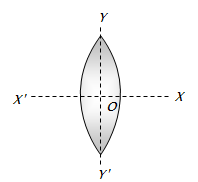
An equiconvex lens is cut into two halves along $\ce{(i) XOX¢}$ and $\ce{(ii) YOY¢}$ as shown in the figure. Let $\ce{f, f ¢, f ¢¢}$ be the focal lengths of the complete lens, of each half in case $(i),$ and of each half in case $(ii),$ respectively

Choose the correct statement from the following
For which regions is Gauss' law true?
The first model of atom in 1898 was proposed by:
Huygen’s principle of secondary wavelets may be used to(a) Find the velocity of light in vacuum (b) Explain the particle behaviour of light(c) Find the new position of the wavefront(d) Explain photoelectric effect


Which of the following statement is true  (a) Velocity of light is constant in all media  (b) Velocity of light in vacuum is maximum
  (c) Velocity of light is same in all reference frames(d) Laws of nature have identical form in all reference frames


When the conductivity of a semiconductor is only due to breaking of covalent bonds, the semiconductor is called: