Two heater wires of equal length are first connected in series and then in parallel. The ratio of heat produced in the two cases is
AIIMS 2000, Medium


Download our appand get started for free
Experience the future of education. Simply download our apps or reach out to us for more information. Let's shape the future of learning together!No signup needed.*
Similar Questions
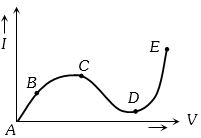
- 1From the graph between current $I$ and voltage $V$ shown below, identify the portion corresponding to negative resistanceView Solution
- 2The resistor of resistance '$R$' is connected to $25\, V$ supply and heat produced in it is $25\, J/sec$. The value of $R$ is .......... $\Omega $View Solution
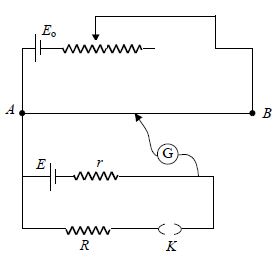
- 3The given figure represents an arrangement of potentiometer for the calculation of internal resistance $(r)$ of the unknown battery $(E)$. The balance length is $70.0\, cm$ with the key opened and $60.0\,cm$ with the key closed. $R$ is $132.40 \Omega $. The internal resistance $(r)$ of the unknown cell will be.......$\Omega$ (Given $E_o > E$) :-View Solution
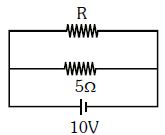
- 4The power dissipated in the circuit shown in the figure is $30\, Watts$. The value of $R$ is ............. $\Omega$View Solution
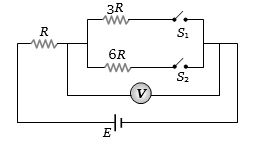
- 5In the circuit shown in figure reading of voltmeter is $V_1$ when only $S_1$ is closed, reading of voltmeter is $ V_2$ when only $S_2$ is closed and reading of voltmeter is $V_3$ when both $S_1$ and $S_2$ are closed. ThenView Solution
- 6There are $0.8 \times 10^{23}$ free electrons $/ cm^3$ in copper. If $0.2\, A $ current is flowing is copper wire, then the drift velocity of electrons will be, if the cross sectional area of wire is $0.01 \,cm^2$View Solution
- 7Two bulbs are working in parallel order. Bulb $A$ is brighter than bulb $B$. If ${R_A}$ and ${R_B}$ are their resistance respectively thenView Solution
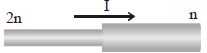
- 8Two cylindrical rods of uniform crosssection area $A$ and $2A$, having free electrons per unit volume $2n$ and $n$ respectively are joined in series. A current $I$ flows through them in steady state. Then the ratio of drift velocity of free electron in left rod to drift velocity of electron in the right rod is $\left( {\frac{{{v_L}}}{{{v_R}}}} \right)$View Solution
- 9The equivalent resistance of the circuit shown in the figure is ............. $\Omega$View Solution
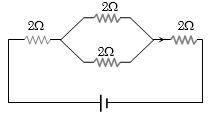
- 10An electric iron draws $5\, amp$, a $TV$ set draws $3\, amp$ and refrigerator draws $2\, amp$ from a $220\, volt$ main line. The three appliances are connected in parallel. If all the three are operating at the same time, the fuse used may be of ............. $amp$View Solution