MCQ
Two heavenly bodies ${S_1}$ and ${S_2}$, not far off from each other are seen to revolve in orbits
  • Around their common centre of mass
  • B
    Which are arbitrary
  • C
    With ${S_1}$ fixed and ${S_2}$ moving round ${S_1}$
  • D
    With ${S_2}$ fixed and ${S_1}$ moving round ${S_2}$
Answer

Correct option: A.
Around their common centre of mass
a
(a) Solution Two heavenly bodies revolving due to refusal Gravitation

Force constitute a Binary stor system. In that, both bodies revolve about their center of

mass by the gravitational force acting as centripetal force for each

option $- A$ correct

Need a full question paper?

Generate a complete, print-ready paper with questions like this in minutes — across 16+ boards, with answer keys.

Start Generating Free

Similar questions

An object is moving in a circle of radius $100 \,m$ with a constant speed of $31.4 \,m/s$. What is its average speed for one complete revolution ......... $m/s$
Which of the following pairs of physical quantities has the same dimensions
An athlete of mass $60\, kg$ skips at the rate of $20$ steps per minute through an average height of $25\,cm$. The power developed is ............. $\mathrm{W}$
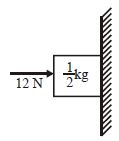
A horizontal force $12 \,N$ pushes a block weighing $1/2\, kg$ against a vertical wall.  The  coefficient of static friction between the wall and the block is $0.5$ and the coefficient of  kinetic friction is $0.35.$ Assuming that the block is not moving  initially. Which one of the following choices is correct (Take $g = 10 \,m/s^2$)
A Merry-go-round, made of a ring-like platform of radius $R$ and mass $M$, is revolving with angular speed $\omega$. A person of mass M is standing on it. At one instant, the person jumps off the round, radially away from the centre of the round (as seen from the round). The speed of the round afterwards is
The magnitude of the vector product of two vectors $\big|\overrightarrow{\text{A}}\big|$ and $\big|\overrightarrow{\text{B}}\big|$ may be:
The thermal capacity of $40\, gm$ of aluminium (specific heat $= 0.2\, cal/gm/°C)$ is ........ $cal/^oC$
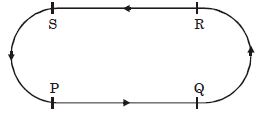
A dancer moves counterclockwise at constant speed around the path shown below. The path is such that the lengths of its segments, $PQ, QR, RS$, and $SP$, are equal. Arcs $QR$ and $SP$ are semicircles. Which of the following best represents the magnitude of the dancer’s acceleration as a function of time $t$ during one trip around the path, beginning at point $P$ ?
In a certain region of space gravitational field is given by $E = \frac {-K}{r}$ where $'r'$ is the distance from a fixed point and $K$ is constant. Taking reference point to be at $r = r_0$ with $V = V_0$ the potential at a distance $r$ is
A ball is thrown vertically upwards with a velocity of $19.6\,ms ^{-1}$ from the top of a tower. The ball strikes the ground after $6\,s$. The height from the ground up to which the ball can rise will be $\left(\frac{ k }{5}\right) m .$ The value of $k$ is ..... (use $g =9.8\,m / s ^{2}$)