Question
Two heavy spheres each of mass $100kg$ and radius $0.10m$ are placed $1.0m$ apart on a horizontal table. What is the gravitational force and potential at the mid point of the line joining the centres of the spheres? Is an object placed at that point in equilibrium? If so, is the equilibrium stable or unstable?
Answer

Gravitational field at the mid-point of the line joining the centres of the two spheres $=\mathrm{GM} /(\mathrm{r} / 2)^2$ (along negative r ) $+\mathrm{GM} /(\mathrm{r} / 2$ ) (along r ) $=0$ Gravitational potential at the midpoint f the line joining the centres of the two spheres is V $=-\mathrm{GM} / \mathrm{r} / 2+(-\mathrm{GM} / \mathrm{r} / 2)=-4 \mathrm{GM} / \mathrm{r}=-4 \times 6.67 \times 10^{-11} \times 100 / 1.0=-2.7 \times 10^{-8} \mathrm{~J} / \mathrm{Kg}$ As the effective force on the body placed at mid-point is zero, sso the body is in equilibrium. If the body is displaced a little towards either mass body from its equilibrium position, it will not return back to its inital position of equilibrium. Hence, the body is in unstable equilibrium.

Need a full question paper?

Generate a complete, print-ready paper with questions like this in minutes — across 16+ boards, with answer keys.

Start Generating Free

Similar questions

What is Simple Harmonic Motion? Show that in $\text{S.H.M}$., acceleration is directly proportional to its displacement at a given instant.
Suppose the bob of the previous problem has a speed of 1.4m/ s when the string makes an angle of 0.20 radian with the vertical. Find the tension at this instant. You can use $\cos\theta\approx1-\frac{\theta^2}{2}$ and $\sin\theta\approx\theta$ for small $\theta.$
What is Graham's law of gas diffusion ? Propound this law on the basis of molecular motion theory.
What are the different properties of the material used in heat thermometer?
A plate of area $10cm^2$ is to be electroplated with copper (density $9000kg/m^3$) to a thickness of 10 micrometres on both sides, using a cell of 12V. Calculate the energy spent by the cell in the process of deposition. If this energy is used to heat 100g of water, calculate the rise in the temperature of the water. ECE of copper = $3 \times 10^{-7}kg C^{-1}$ and specific heat capacity of water = $4200Jkg^{-1}$.
At what temperature will the average velocity of oxygen molecules be sufficient so as to escape from the earth? Escape velocity from the earth is $11.0km/sec$ and the mass of one molecule of oxygen is $5.34 \times 10^{-26}kg$ (Boltzmann constant $k = 1.38 \times 10^{-23} Joule/K)$.
The moments of inertia of two rotating bodies A and B are $l_A$ and $I_B. (I_A > I_B)$ and their angular moment are equal. Which one has greater K.E.?
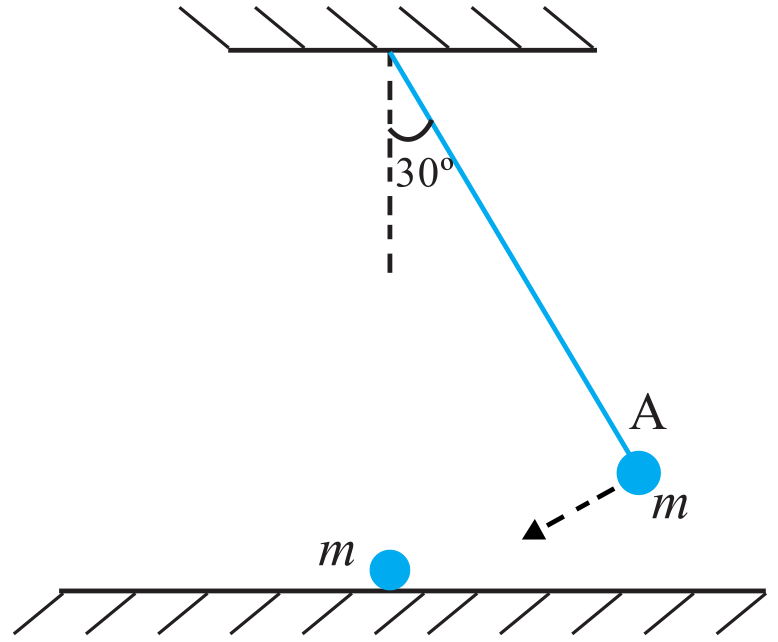
The bob A of a pendulum released from 30° to the vertical hits another bob B of the same mass at rest on a table as shown in. How high does the bob A rise after the collision? Neglect the size of the bobs and assume the collision to be elastic.
$\text{ }^{197}_{80}\text{Hg}$ decay to $\text{ }^{197}_{79}\text{Au}$ through electron capture with a decay constant of $0.257$ per day.
  1. What other particle or particles are emitted in the decay?
  2. Assume that the electron is captured from the $K$ shell. Use Moseley's law $\sqrt{\text{v}}=\text{a(Z}-\text{b})$ with $\text{a}=4.95\times10^7\text{s}^{-\frac{1}{2}}$ and $b = 1$ to find the wavelength of the $\text{K}_{\alpha} X-$ray emitted following the electron capture.
A wheel of mass 10kg and radius 20cm is rotating at an angular speed of 100rev/min when the motor is turned off. Neglecting the friction at the axle, calculate the force that must be applied tangentially to the wheel to bring it to rest in 10 revolutions.