Two hollow conducting spheres of radii $R_{1}$ and $R_{2}$ $\left(R_{1}>>R_{2}\right)$ have equal charges. The potential would be:
NEET 2022, Easy
Download our app for free and get started
$V =\frac{1}{4 \pi \epsilon_{0}} \cdot \frac{ Q }{ R }$
$\frac{1}{4 \pi \epsilon_{0}}=\text { constant }$
$Q =\text { same (Given) }$
$\therefore V \propto \frac{1}{ R }$
$\therefore$ Potential is more on smaller sphere.

Download our appand get started for free
Experience the future of education. Simply download our apps or reach out to us for more information. Let's shape the future of learning together!No signup needed.*
Similar Questions
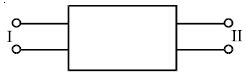
- 1If a battery of voltage $V$ is connected across terminals $I$ of the block box shown in figure, an ideal voltmeter connected to terminals $II$ gives a reading of $V/2$, while if the battery is connected to terminals $II$, a voltmeter across terminals $I$ reads $V$. The black box may containView Solution
- 2$1000$ small water drops each of capacitance $C$ join together to form one large spherical drop. The capacitance of bigger sphere is ......... $C$View Solution
- 3Between the plates of a parallel plate condenser there is $1\,mm$ thick paper of dielectric constant $4$. It is charged at $100\;volt$. The electric field in $volt/metre$ between the plates of the capacitor isView Solution
- 4A capacitor $C$ is charged to a potential difference $V$ and battery is disconnected. Now if the capacitor plates are brought close slowly by some distance :View Solution
- 5View SolutionThe electric potential inside a conducting sphere
- 6View SolutionWhile a capacitor remains connected to a battery and dielectric slab is applied between the plates, then
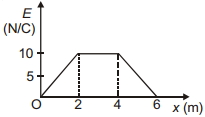
- 7Figure shows the variation of electric field intensity $E$ versus distance $x$. What is the potential difference between the points at $x=2 \,m$ and at $x=6 \,m$ from $O$ is ............. $V$View Solution
- 8A parallel plate capacitor with width $4\,cm$, length $8\,cm$ and separation between the plates of $4\,mm$ is connected to a battery of $20\,V$. A dielectric slab of dielectric constant $5$ having length $1\,cm$, width $4\,cm$ and thickness $4\,mm$ is inserted between the plates of parallel plate capacitor. The electrostatic energy of this system will be......... $\in_{0}\,J$. (Where $\in_{0}$ is the permittivity of free space)View Solution
- 9Three capacitors of capacitance $1\ \mu F$, $2 \ \mu F$ and $3\ \mu F$ are connected in series and a potential difference of $11 V$ is applied across the combination. Then, the potential difference across the plates of $1\ \mu F$ capacitor is......$V$View Solution
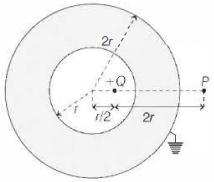
- 10Consider an initially neutral hollow conducting spherical shell with inner radius $r$ and outer radius $2 r$. A point charge $+Q$ is now placed inside the shell at a distance $r / 2$ from the centre. The shell is then grounded by connecting the outer surface to the earth. $P$ is an external point at a distance $2 r$ from the point charge $+Q$ on the line passing through the centre and the point charge $+Q$ as shown in the figure. The magnitude of the force on a test charge $+q$ placed at $P$ will beView Solution