MCQ
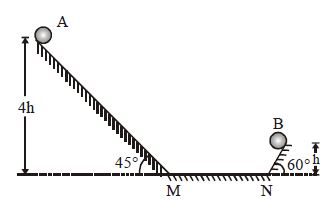
Two identical balls $A$ and $B$ are released from the positions shown in figure. They collide elastically on horizontal portion $MN$ . The ratio of the heights attained by $A$ and $B$ after collision will be : (neglect friction)
  • A
    $1 : 4$
  • B
    $2 : 1$
  • $4 : 13$
  • D
    $2 : 5$

Answer

Correct option: C.
$4 : 13$
c
When the two balls collide with each other as the mass of the two balls is equal, they exchange their velocities on colliding elasticaslly. Let the speed of the ball $\mathrm{B}$ when it reaches back ot the initial position be $v$. then

$4 m g h=\frac{1}{2} m v^{2}+m g h \Rightarrow v=\sqrt{6 g h}$

Height reached by particle $B$ (from highest point the incline)

$H_{B}=\frac{v^{2} \sin ^{2} 60^{\circ}}{2 g}=\frac{9 h}{4},$ total height $=h+\frac{9 h}{4}=\frac{13 h}{4}$

after collision the partcle $A$ reaches the maximum height $=h$

Ratio $=\frac{H_{A}}{H_{B}}=\frac{4}{13}$

Need a full question paper?

Generate a complete, print-ready paper with questions like this in minutes — across 16+ boards, with answer keys.

Start Generating Free

Similar questions

The acceleration due to gravity at a height $1\, km$ above the earth is the same as at a depth $d$ below the surface of earth. Then  $d\,=$ ......... $km$
The value of work done on the system by all types of forces (external and internal) is equal to:
A body $x$ with a momentum $p$ collides with another identical stationary body $y$ one dimensionally. During the collision $y$ gives an impulse $J$ to body $x$. Then coefficient of restitution is
A body of mass $5\, kg$ moving with a velocity $10\,m/s$ collides with another body of the mass $20 \,kg$ at, rest and comes to rest. The velocity of the second body due to collision is ......... $m/s$
A projectile is thrown at an angle '$\theta '$ to the horizontal from $O$ and it hits the ground at $O'$. During the entire motion (select the wrong statement)
An aeroplane is flying with a uniform speed of $100\, m/s$ along a circular path of radius $100 m$. the angular speed of the aeroplane will be ......... $rad/sec$
In which of the following systems will the radius of the first orbit (n = 1) be minimum?
  1. Hydrogen atom.
  2. Deuterium atom.
  3. Singly ionized helium.
  4. Doubly ionized lithium.
The value of acceleration due to gravity at Earth’s surface is $9.8\, m\,s^{-2}$. The altitude above its surface at which the acceleration due to gravity decreases to $4.9\, m\,s^{-2}$, is close to: (Radius of earth $= 6.4\times10^6\, m$)
When $0.93\,watt-hour$ of energy is supplied to a block of ice weighing $10\,g,$ it is found that
Two masses $m$ and $M$ are attached to the strings as shown in the figure. If the system is in equilibrium, then