MCQ
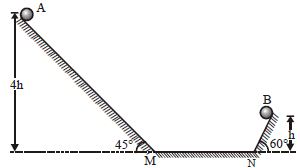
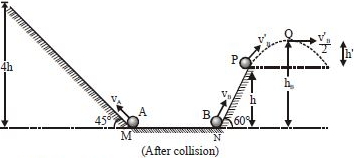
Two identical balls $A$ and $B$ are released from the positions shown in figure. They collide elastically on horizontal portion $MN$. The ratio of the height attained by $A$ and $B$ after collision will be: (neglect friction)
  • A
    $1 : 4$
  • B
    $2 : 1$
  • $4 : 13$
  • D
    $2 : 5$

Answer

Correct option: C.
$4 : 13$
c
After the collision the balls exchange their velocities, i.e.

$v_{A}=\sqrt{2 g h} \quad \text { and } \quad v_{B}=2 \sqrt{2 g h}$

Height attained by $A$ will be

$\mathrm{h}_{\mathrm{A}}=\frac{\mathrm{v}_{\mathrm{A}}^{2}}{2 \mathrm{g}}=\mathrm{h}$            $...(1)$

But path of $B$ will be first straight line from $N$ to $\mathrm{P}$ and then parabolic from point $\mathrm{P}$ as shown in fig.

Calculation of max height attained by $B.$ velocity of $\mathrm{B}$ at point $\mathrm{P}$

$\mathrm{v}_{\mathrm{B}}^{\prime 2}=\mathrm{v}_{\mathrm{B}}^{2}-2 \mathrm{gh}=6 \mathrm{gh}$             $...(2)$

After reaching at point $P$ it will move in parabolic height.

So here $h^{\prime}=\frac{v_{B}^{\prime 2}\left(\sin 60^{\circ}\right)^{2}}{2 g}=\frac{9 h}{4}$

$\Rightarrow$ max. height attained by $\mathrm{B}$

$h_{B}=h+h^{\prime}=h+\frac{9 h}{4}=\frac{13 h}{4}$         $...(3)$

from eq" $( 1)$ $\&$ $(3)$

$\frac{h_{A}}{h_{B}}=\frac{4}{13}$
Need a full question paper?

Generate a complete, print-ready paper with questions like this in minutes — across 16+ boards, with answer keys.

Start Generating Free

Similar questions

A cylindrical vessel filled with water upto height of $H$ stands on a horizontal plane. The side wall of the vessel has a plugged circular hole touching the bottom. The coefficient of friction between the bottom of vessel and plane is $\mu$ and total mass of water plus vessel is $M$. What should be minimum diameter of hole so that the vessel begins to move on the floor if plug is removed (here density of water is $\rho$ )
The time period of polar satellites is about ..........
 A $10 \;N$ force is applied on a body produce in it an acceleration of $1 \;m / s ^{2} .$ The mass of the body is ...... $kg$
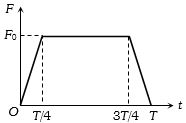
A particle of mass m moving with a velocity $u$ makes an elastic one dimensional collision with a stationary particle of mass $m$ establishing a contact with it for extremely small time $T$. Their force of contact increases from zero to $F_0$ linearly in time $\frac{T}{4}$, remains constant for a further time $\frac{T}{2}$ and decreases linearly from  $F_0$  to zero in further time $\frac{T}{4}$ as shown. The magnitude possessed by $F_0$  is
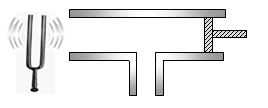
Vibrating tuning fork of frequency $n$ is placed near the open end of a long cylindrical tube. The tube has a side opening and is fitted with a movable reflecting piston. As the piston is moved through $8.75 cm$, the intensity of sound changes from a maximum to minimum. If the speed of sound is $350 \,m/s. $ Then $n$ is .... $Hz$
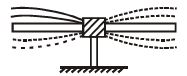
A rod of length $1.2\,m$ is clamped at the mid point and its fundamental frequency is $2\,MHz$ , then speed of wave inside the rod?
If the dimensions of length are expressed as ${G^x}{c^y}{h^z}$; where $G,\,c$ and $h$ are the universal gravitational constant, speed of light and Planck's constant respectively, then
A uniform stick of mass $M$ and length $L$ is pivoted at its centre. Its ends are tied to two springs each of force constant $K$ . In the position shown in figure, the strings are in their natural length. When the stick is displaced through a small angle $\theta $ and released. The stick
A big drop is formed by coalescing $1000$ small identical drops of water. If $E_1$ be the total surface energy of $1000$ small drops of water and $E_2$ be the surface energy of single big drop of water, the $E_1$ : $\mathrm{E}_2$ is $\mathrm{x}: 1$ where $x$ =_____.
A light rod of length $200\,cm$ is suspended from the ceiling horizontally by means of two vertical wires of equal length tied to its ends. One of the wires is made of steel and is of cross-section $0.1\,cm^2$ and the other of brass of cross-section $0.2\,cm^2$ . Along the rod at which distance a weight may be hung to produce equal stresses in both the wires?