MCQ
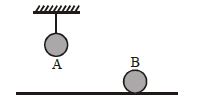
Two identical balls, $A$ and $B$ , of uniform composition and initially at the same temperature, each absorb exactly the same amount of heat. $A$ is hanging down from the ceiling while $B$ rests on the horizontal floor in the same room. Assuming no subsequent heat loss by the balls, which of the following statements is correct about their final temperatures, $T_A$ and $T_B$ , once the balls have reached their final state?
  • A
    $T_A < T_B$
  • $T_A > T_B$
  • C
    $T_A = T_B$
  • D
    $T_A \leq  T_B$

Answer

Correct option: B.
$T_A > T_B$
b
When the balls are warmed, their centre of masses are moving as radii of balls are increasing. The centre of mass of ball $A$ will come down and that of ball $B$ will go up.In case of ball $A,$ the gravitational potential energy decreases.This corresponds to additional heating of ball.

$T_{A}>T_{B}$

Need a full question paper?

Generate a complete, print-ready paper with questions like this in minutes — across 16+ boards, with answer keys.

Start Generating Free

Similar questions

Two parallel wires are carrying electric currents of equal magnitude and in the same direction. They exert
A varying current in a coil changes from $10\, amp$ to zero in $0.5 \,sec$. If average $EMF$ is induced in the coil is $220 \,volts$, the self inductance of coil is....$H$
A pin or a needle floats on the surface of water, the reason for this is
A rope of negligible mass is wound round a hollow cylinder of mass $3\, kg$ and radius  $40\, cm$. If rope is pulled with a force of $30\, N$, then the angular acceleration  produced in the cylinder is ........ $rad\, s^{-2}$.
Three bodies $A, B$ and $C$ of masses $m, m$ and $\sqrt 3\,m$ respectively are supplied heat at a constant rate. The change in temperature $\theta $ versus time $t$ graph for $A, B$ and $C$ are shown by $I, II$ and $III$ respectively. If their specific heat capacities are $S_A, S_B$ and $S_C$ respectively then which of the following relation is correct ? (Initial temperature of body is $0\,^oC$ )
A particle moves in x-y plane under the influence of a force $\overrightarrow{ F }$ such that its linear momentum is $\overrightarrow{ P }( t )=\hat{ i } \cos ( kt )-\hat{ j } \sin ( kt )$ . If $k$ is constant, the angle between $\overrightarrow{ F }$ and $\overrightarrow{ P }$ will be :
A proton moving with a velocity, $2.5 \times {10^7}\,m/s$, enters a magnetic field of intensity $2.5\,T$ making an angle ${30^o}$ with the magnetic field. The force on the proton is
Assertion $(A):$ A spherical equipotential surface is not possible for a point charge.

Reason $(R):$ A spherical equipotential surface is possible inside a spherical capacitor.

A man of weight $80\, kg$ is standing in an elevator which is moving with an acceleration of $6\,\,m/{s^2}$ in upward direction. The apparent weight of the man will be  ......... $N$ $(g = 10\,m/{s^2})$
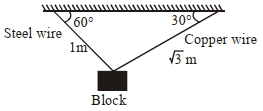
A block of weight $100 N$ is suspended by copper and steel wires of same cross sectional area $0.5 cm ^2$ and, length $\sqrt{3} m$ and $1 m$, respectively. Their other ends are fixed on a ceiling as shown in figure. The angles subtended by copper and steel wires with ceiling are $30^{\circ}$ and $60^{\circ}$, respectively. If elongation in copper wire is $\left(\Delta \ell_{ C }\right)$ and elongation in steel wire is $\left(\Delta \ell_{ s }\right)$, then the ratio $\frac{\Delta \ell_{ C }}{\Delta \ell_{ S }}$ is. . . . . .

[Young's modulus for copper and steel are $1 \times 10^{11} N / m ^2$ and $2 \times 10^{11} N / m ^2$ respectively]