MCQ
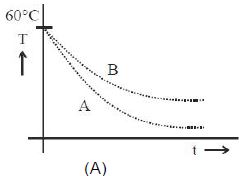
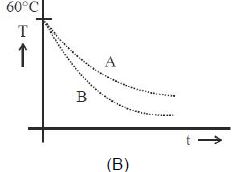
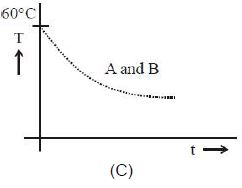
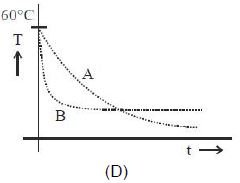
Two identical beakers $A$ and $B$ contain equal volumes of two different liquids at $60\,^oC$ each and left to cool down. Liquid in $A$ has density of $8 \times10^2\, kg / m^3$ and specific heat of $2000\, Jkg^{-1}\,K^{-1}$ while liquid in $B$ has density of $10^3\,kgm^{-3}$ and specific heat of $4000\,JKg^{-1}\,K^{-1}$ . Which of the following best describes their temperature versus time graph schematically? (assume the emissivity of both the beakers to be the same)

  • B

  • C

  • D

Answer

Correct option: A.

a
$ - ms\frac{{dT}}{{dt}} = e\sigma A\left( {{T^4} - T_0^4} \right)$

$ - \frac{{dT}}{{dt}} = \frac{{e\sigma A}}{{ms}}\left( {{T^4} - T_0^4} \right)\,\,;\,\, - \frac{{dT}}{{dt}} = \frac{{4e\sigma AT_0^3}}{{ms}}\left( {\Delta T} \right)$

$T = {T_0} + \left( {{T_i} - {T_0}} \right){e^{ - kt}}$

$where\,k = \frac{{4e\sigma AT_0^3}}{{ms}}$

$k = \frac{{4e\sigma AT_0^3}}{{\rho vs}}\,\,;\,\,\left| {\frac{{dT}}{{dt}}} \right| \propto k$

$\therefore \left| {\frac{{dT}}{{dt}}} \right| \propto \frac{1}{{\rho s}}$

$\rho A{S_A} = 2000 \times 8 \times {10^2} = 16 \times {10^5}$

${\rho _B}{S_B} = 4000 \times {10^3} = 4 \times {10^6}$

${\rho _A}{S_A} < {\rho _B}{S_B}$

${\left| {\frac{{dT}}{{dt}}} \right|_A} > {\left| {\frac{{dT}}{{dt}}} \right|_B}$

Need a full question paper?

Generate a complete, print-ready paper with questions like this in minutes — across 16+ boards, with answer keys.

Start Generating Free

Similar questions

Four particles, each of mass $M$ and equidistant from each other, move along a circle of radius $R$ under the action of their mutual gravitational attraction. The speed of each particle is
A source is moving towards an observer with a speed of $20 m/s$ and having frequency of $240 Hz.$ The observer is now moving towards the source with a speed of $20 m/s$. Apparent frequency heard by observer, if velocity of sound is $340 m/s$, is ... $Hz$
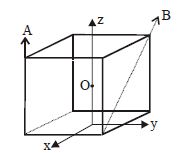
With reference to figure of a cube of edge $a$ and mass $m$, state whether the following
($O$ is the centre of the cube.) option is correct

$(a)$ The moment of inertia of cube about $z-$ axis is $I_z$ = $I_x + I_y$

$(b)$ The moment of inertia of cube about $A-$ axis is $I_A$=${I_z} + \frac{{m{a^2}}}{2}$

$(c)$ The moment of inertia of cube about $B-$ axis is $I_B$=${I_z} + \frac{{m{a^2}}}{2}$

$(d)$  $I_x$ = $I_z$

A sphere, a cube and a thin circular plate; all are of the same material and same mass and all of them are initially heated to same high temperature. Then:
A spaceship in space sweeps stationary interplanetary dust. As a result, its mass increases at a rate $\frac{ dM ( t )}{ dt }= bv ^{2}( t ),$ where $v ( t )$ is its instantaneous velocity. The instantaneous acceleration of the satellite is
$K.E.$ of molecular motion appears as:
Suppose that the angular velocity of rotation of earth is increased. Then, as a consequence.
A particle is executing $SHM$ of amplitude $A,$ about the mean position $x = 0.$ Which of the following cannot be a possible phase difference between the positions of the particle at $x = +\,A/2$ and $x = - A/\sqrt {2} .$
A monoatomic gas performs a work of $\frac{Q}{4}$ where $Q$ is the heat supplied to it. The molar heat capaticy of the gas will be $R$ during this transformation. Where $R$ is the gas constant.
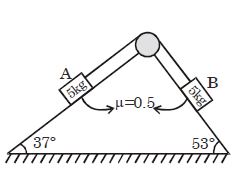
In the shown arrangement if $f_A\,,\, f_B$ and $T$ be the frictional forces on $A$ Block, $B$ Block and tension in the string respectively, then their values are