MCQ
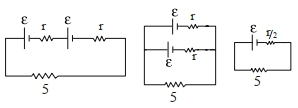
Two identical cells, when connected either in parallel or in series gives same current in an external resistance $5\,\Omega$. The internal resistance of each cell will be $.............\,\Omega$.
  • $5$
  • B
    $4$
  • C
    $3$
  • D
    $2$

Answer

Correct option: A.
$5$
a
$i=\frac{2 \varepsilon}{5+2 r}........(1)$

$i=\frac{\varepsilon}{\frac{r}{2}+5}.........(2)$

Equating $(1)$ and $(2)$

$\frac{2 \varepsilon}{5+2 r }=\frac{\varepsilon}{\frac{ r }{2}+5} \Rightarrow r +10=5+2 r$

$r=5$

Ans.$5$
Need a full question paper?

Generate a complete, print-ready paper with questions like this in minutes — across 16+ boards, with answer keys.

Start Generating Free

Similar questions

Two bulbs of $100\, W$ and $200\, W$ working at $220$ $volt$ are joined in series with $220$ $volt$ supply. Total power consumed will be approximately ........... $watt$
A uniform heavy rod of mass $20\,kg$. Cross sectional area $0.4\,m ^{2}$ and length $20\,m$ is hanging from a fixed support. Neglecting the lateral contraction, the elongation in the rod due to its own weight is $x \times 10^{-9} m$. The value of $x$ is

(Given. Young's modulus $Y =2 \times 10^{11} Nm ^{-2}$ અને $\left.g=10\, ms ^{-2}\right)$
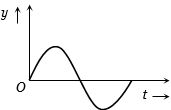
The displacement time graph of a particle executing $S.H.M.$ is as shown in the figureThe corresponding force-time graph of the particle is
A dense collection of equal number of electrons and positive ions is called neutral plasma. Certain solids containing fixed positive ions surrounded by free electrons can be treated as neutral plasma. Let ' $N$ ' be the number density of free electrons, each of mass ' $m$ '. When the electrons are subjected to an electric field, they are displaced relatively away from the heavy positive ions. If the electric field becomes zero, the electrons begin to oscillate about the positive ions with a natural angular frequency ' $\omega_p$ ', which is called the plasma frequency. To sustain the oscillations, a time varying electric field needs to be applied that has an angular frequency $\omega$, where a part of the energy is absorbed and a part of it is reflected. As $\omega$ approaches $\omega_{ p }$, all the free electrons are set to resonance together and all the energy is reflected. This is the explanation of high reflectivity of metals.

$1.$ Taking the electronic charge as ' $e$ ' and the permittivity as ' $\varepsilon_0$ ', use dimensional analysis to determine the correct expression for $\omega_p$.

$(A)$ $\sqrt{\frac{N e}{m \varepsilon_0}}$ $(B)$ $\sqrt{\frac{m \varepsilon_0}{N e}}$ $(C)$ $\sqrt{\frac{N e^2}{m \varepsilon_0}}$ $(D)$ $\sqrt{\frac{m \varepsilon_0}{N e^2}}$

$2.$ Estimate the wavelength at which plasma reflection will occur for a metal having the density of electrons $N \approx 4 \times 10^{27} m ^{-3}$. Take $\varepsilon_0 \approx 10^{-11}$ and $m \approx 10^{-30}$, where these quantities are in proper $SI$ units.

$(A)$ $800 \ nm$ $(B)$ $600 \ nm$ $(C)$ $300 \ nm$ $(D)$ $200 \ nm$

Give the answer question $1$ and $2.$ 
The decay constant of radium is $4.28 \times {10^{ - 4}}$ per year. Its half life will be ..........$years$
A bullet moving with a uniform velocity v, stops suddenly after hitting the target and the whole mass melts be $m$, specific heat $S,$ initial temperature $25°C$ melting point $ 475°C$ and the latent heat $L.$ Then $v$ is given by
An initially uncharged capacitor $C$ is being charged by a battery of emf $E$ through a resistance $R$ upto the instant, when the capacitor is charged to the potential $E / 2$, then the ratio of the work done by the battery to the heat dissipated by the resistor is given by
A light source of wavelength $\lambda$ illuminates a metal surface and electrons are ejected with maximum kinetic energy of 2 eV . If the same surface is illuminated by a light source of wavelength $\frac{\lambda}{2}$, then the maximum kinetic energy of ejected electrons will be (The work function of metal is 1 eV )
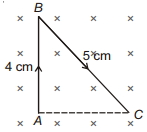
A uniform conducting wire $A B C$ has a mass of $10 \,g$. A current of $2 \,A$ flows through it. The wire is kept in a uniform magnetic field $B=2 T$. The acceleration of the wire will be ............. $ms ^{-2}$
What should be the order of arrangement of de-Broglie wavelength of elelctron $\left(\lambda_{{e}}\right)$, an $\alpha-$ particle $\left(\lambda_{\alpha}\right)$ and proton $\left(\lambda_{p}\right)$ given that all have the same kinetic energy ?