MCQ
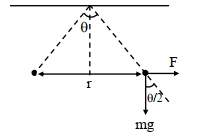
Two identical charged spheres are suspended by strings of equal lengths. The strings make an angle $\theta$ with each other. When suspended in water the angle remains the same. If density of the material of the sphere is $1.5 \mathrm{~g} / \mathrm{cc}$, the dielectric constant of water will be

(Take density of water $=1 \mathrm{~g} / \mathrm{cc}$ )

  • A
    $4$
  • B
    $8$
  • C
    $7$
  • $3$

Answer

Correct option: D.
$3$
d
In air $\tan \frac{\theta}{2}=\frac{F}{m g}=\frac{q^2}{4 \pi \varepsilon_0 \mathrm{r}^2 m g}$

In water $\tan \frac{\theta}{2}=\frac{\mathrm{F}^{\prime}}{\mathrm{mg}^{\prime}}=\frac{\mathrm{q}^2}{4 \pi \varepsilon_0 \varepsilon_{\mathrm{r}} \mathrm{r}^2 \mathrm{mg}_{\text {eff }}}$

Equate both equations

$\varepsilon_0 g=\varepsilon_0 \varepsilon_{\mathrm{r}} \mathrm{g}\left[1-\frac{1}{1.5}\right]$

$\varepsilon_{\mathrm{T}}=3$

Need a full question paper?

Generate a complete, print-ready paper with questions like this in minutes — across 16+ boards, with answer keys.

Start Generating Free

Similar questions

For a transistor amplifier in common emitter configuration for load impedance of $1 k$$\Omega$($h_{fe} = 50$ and $h_{oe} = 25$ $\mu A/V$) the current gain is
A thin convex lens made from crown glass $\left( {\mu = \frac{3}{2}} \right)$ has focal length $f$. When it is measured in two different liquids having refractive indices $\frac{4}{3}$ and $\frac{5}{3}$ it has the focal lengths $f_1$ and $f_2$ respectively. The correct relation between the focal lengths is:
Two electric bulbs have tungsten filament of same length. If one of them gives $60\ W$ and the other $100\ W$ , then
Three weights $W, 2W$ and $3W$ are connected to identical springs suspended from a rigid horizontal rod. The assembly of the rod and the weights fall freely. The positions of the weights from the rod are such that
Why the dam of water reservoir is thick at the bottom
A system is provided with $200 \,cal$ of heat and the work done by the system on the surrounding is $40 \,J$. Then its internal energy
A body executes simple harmonic motion under the action of a force $F_1$ with a time period $(4/5)\, sec$. If the force is changed to $F_2$ it executes $SHM$ with time period $(3/5)\, sec$. If both the forces $F_1$ and $F_2$ act simultaneously in the same direction on the body, its time period (in $seconds$ ) is
A particle of mass $m$ is moving in a circular orbit under the influence of the central force $F(r)=-k r$, corresponding to the potential energy $V(r)=k r^2 / 2$, where $k$ is a positive force constant and $r$ is the radial distance from the origin. According to the Bohr's quantization rule, the angular momentum of the particle is given by $L=n h$, where $h=h /(2 \pi), h$ is the Planck's constant, and $n$ a positive integer. If $v$ and $E$ are the speed and total energy of the particle, respectively, then which of the following expression($s$) is(are) correct?

$(A)$ $r^2=n h \sqrt{\frac{1}{m k}}$

$(B)$ $v^2=n h \sqrt{\frac{k}{m^3}}$

$(C)$ $\frac{L}{m r^2}=\sqrt{\frac{k}{m}}$

$(D)$ $E=\frac{n h}{2} \sqrt{\frac{k}{m}}$

The distance $x$ covered by a particle in one dimensional motion varies with time $t$ as $\mathrm{x}^{2}=\mathrm{at}^{2}+2 \mathrm{bt}+\mathrm{c.}$ If the acceleration of the particle depends on $\mathrm{x}$ as $\mathrm{x}^{-\mathrm{n}},$ where $\mathrm{n}$ is an integer, the value of $\mathrm{n}$ is
In the case of constants $\alpha$ and $\beta$ of a transistor