MCQ
Two identical current carrying coaxial loops, carry current I in an opposite sense. A simple amperian loop passes through both of them once. Calling the loop as C:
  • A
    $\oint\text{B.dl}=\pm2\mu_0\text{I}.$
  • B
    The value of $\oint\text{B.dl}$ is independent of sense of C.
  • C
    There may be a point on C where B and dl are perpendicular.
  • D
    B vanishes every where on C.

Answer

  1. The value of $\oint\text{B.dl}$ is independent of sense of C.
  2. There may be a point on C where B and dl are perpendicular.

Solution:

Key concept: Ampere’s law gives another method to calculate the magnetic field due to a given current distribution.
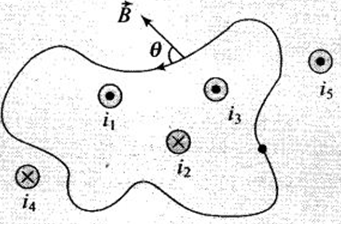
Line integral of the magnetic field $\vec{\text{B}}$ around any closed curve is equal to $\mu_0$ times the net current i threading through the area enclosed by the curve, i.e.,

$\oint\vec{\text{B}}.\vec{\text{dI}}=\mu_0\sum\text{i}=\mu_0(\text{i}_1+\text{i}_3-\text{i}_2)$

Total current crossing the above area is (i1 + i3 - i2). Any current outside the area is not included in net current. $(\text{Outward}\ \circledcirc\rightarrow\ +\text{ve},\text{ Inward}\ \otimes\ \rightarrow\ -\text{ve})$

Applying the Ampere's circuital law, we have

$\oint\ \text{B.dl}=\text{i}_0(\text{I}-\text{I})=0$ (because current is in opposite sense.)

Also, there may be a point on C where B and dl are perpendiclular and hence,

$\oint\limits_\text{c}\text{B.dI}=0.$

Need a full question paper?

Generate a complete, print-ready paper with questions like this in minutes — across 16+ boards, with answer keys.

Start Generating Free

Similar questions

A sine wave is travelling in a medium. A particular particle has zero displacement at a certain instant. The particle closest to it having zero displacement is at a distance:

  1. $\frac{\lambda}{4}$

  2. $\frac{\lambda}{3}$

  3. $\frac{\lambda}{2}$

  4. $\lambda.$

50% of the X-ray coming from a Coolidge tube is able to pass through a 0.1mm thick aluminium foil. The potential difference between the target and the filament is increased. The thickness of the aluminium foil that will allow 50% of the X-ray to pass through will be:
  1. zero
  2. < 0.1mm
  3. 0.1mm
  4. > 0.1mm

Two long wires are hanging freely. They are joined first in parallel and then in series and then are connected with a battery. In both cases, which type of force acts between the two wires

(a) Attraction force when in parallel and repulsion force when in series

(b) Repulsion force when in parallel and attraction force when in series

(c) Repulsion force in both cases

(d) Attraction force in both cases

Two magnets, each of magnetic moment ‘M’ are placed so as to form a cross at right angles to each other. The magnetic moment of the system will be

(a) 2M

(b)  

(c) 0.5 M   

(d) M

The angle of dip is the angle

(a) Between the vertical component of earth's magnetic field and magnetic meridian

(b) Between the vertical component of earth's magnetic field and geographical meridian

(c) Between the earth's magnetic field direction and horizontal direction

(d) Between the magnetic meridian and the geographical meridian

A charged particle of mass 0.003 gm is held stationary in space by placing it in a downward direction of electric field of  6 . Then the magnitude of the charge is

(a) 5  

(b) 5 

(c) -18  

(d) -5 

The radius of the first (lowest) orbit of the hydrogen atom is  The radius of the second (next higher) orbit will be

(a) 4 

(b) 6 

(c) 8 

(d) 10 

Fusion reactions take place at about:

A moving coil galvanometer has N number of turns in a coil of effective area A, it carries a current I. The magnetic field B is radial. The torque acting on the coil is

(a)  

(b)  

(c)  

(d) NABI

At a specific instant emission of radioactive compound is deflected in a magnetic field. The compound can emit

(i) Electrons  (ii) Protons (iii)   (iv) Neutrons

The emission at the instant can be

(a) i, ii, iii

(b) i, ii, iii, iv

(c) iv 

(d) ii, iii